

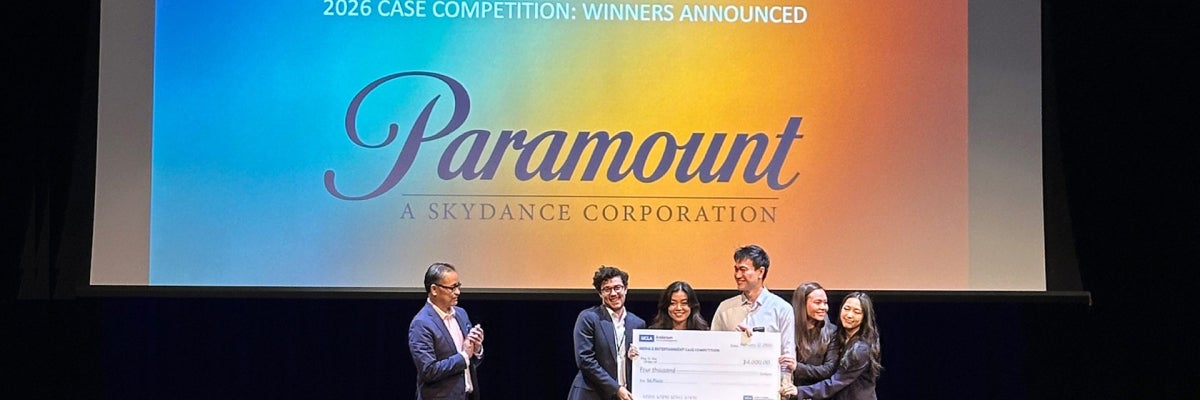
Paramount VP Howard Hsieh (’09) explains the value to students and studios
- UCLA Anderson hosts the annual <a href="https://axiomcore.info/diwali-big-film-releases-to-boost-media-<a href="https://axiomcore.info/entertainment-reporters-exchange-insults-in-media-war-over-paramount-scoop-its-called-reporting/” title=”Entertainment Reporters Exchange Insults in Media War Over Paramount Scoop: ‘It’s Called Reporting’”>entertainment-sector-in-q3fy27-nuvama/” title=”Diwali, Big Film Releases To Boost Media & Entertainment Sector In Q3FY27: Nuvama”>Entertainment and Media Case Competition, open to MBA students from leading business schools
- Executives from Paramount Pictures and other companies hear students’ strategies to resolve a real-life entertainment industry challenge
- Alumnus Howard Hsieh, a Paramount VP, explains why and how companies benefit from partnering this way with Anderson
Each year, MBA students from leading business schools gather on the UCLA campus to analyze a real-life entertainment industry challenge as part of UCLA Anderson’s Entertainment and Media Case Competition, presenting their strategies to executives from Paramount Pictures and other companies.
Howard Hsieh (’09), vice president of strategic planning and business development at Paramount Pictures and an alumnus of UCLA Anderson, has played a central role in sustaining that relationship. For over a decade, Paramount has supported and helped shape the competition — known colloquially as the Paramount Case Competition — by creating content and sending executives to judge the student presentations.
In his role at Paramount, Hsieh focuses on long‑term strategy and emerging business opportunities, examining how audiences are consuming content and where new growth opportunities may exist across film, streaming and other media platforms.
Hsieh explains how the Paramount Case Competition began, why the studio continues to participate and how companies benefit from engaging with leading business schools.
From Paramount’s point of view, what value does the company get from its association with UCLA Anderson — and from the case competition, specifically?
Just the sheer access to the intellectual curiosity that the students have is really powerful. As an alumnus myself, I know the caliber of the program and the students. When we bring a real business question to the competition, we hear ideas and solutions from people who are incredibly smart and who are also consumers of the content we produce. I’ve always told the students they’re actually our number one customer. They watch our movies and our shows, they love the brands, so the competition gives us a chance to hear directly from them.
How did the competition get started?
The origin story actually goes back to an Anderson student who interned at Paramount. He suggested the idea of a case competition through the Entertainment Management Association, and we thought it would be a great way to connect the studio with students who were interested in the business. The first year was very small, maybe eight teams, but it was clear right away that the format worked. Over time it grew into something that’s become a tradition. It’s a good example of how a small idea can turn into something meaningful when people on both sides are excited about it.
The competition has now been running for more than a decade. Why has Paramount continued participating for so long?
Media and entertainment have gone through a lot of change over the last 10 years, and the competition gives us a way to hear how students are thinking about the industry at any given moment. Each year, we bring a topic that reflects where the business is at that time and ask the teams to present their ideas. The students consistently bring thoughtful and creative perspectives, and that’s one of the reasons the partnership has lasted.
Turning it around, what do you think UCLA Anderson and its students gain from the relationship?
For students, it’s an opportunity to work on a real business problem and present their ideas to people who are actually working in the industry. They have to analyze the situation, develop a strategy and communicate it clearly to executives. That kind of experience connects what they’re learning in the classroom with the kinds of decisions companies are making every day.
You also recruit colleagues from Paramount to serve as judges. What do those executives get out of participating?
One of the things judges enjoy is hearing how students approach the business from a fresh perspective. When you’re working in an industry every day, you can sometimes get very focused on immediate challenges. The competition gives executives a chance to step back and hear ideas from people who aren’t embedded in the day‑to‑day environment. The presentations are often creative, and the teams bring a level of analysis that’s really impressive.
More broadly, what would you tell other executives across Los Angeles about the value of engaging with a business school like UCLA Anderson?
Business schools are places where a lot of interesting conversations are addressing strategy, technology and consumer behavior. Engaging with students gives companies a chance to stay connected to those ideas and to the next generation of talent. For Anderson, partnerships like this bring the business community into the classroom. For companies, it’s an opportunity to build relationships and hear new perspectives from people who may become future leaders in the industry.

2 Comments
Pingback: Albertsons turns to microdramas for new retail media offering - Axiom Core
Pingback: Pacers Sports & Entertainment launches retail media network - Axiom Core