

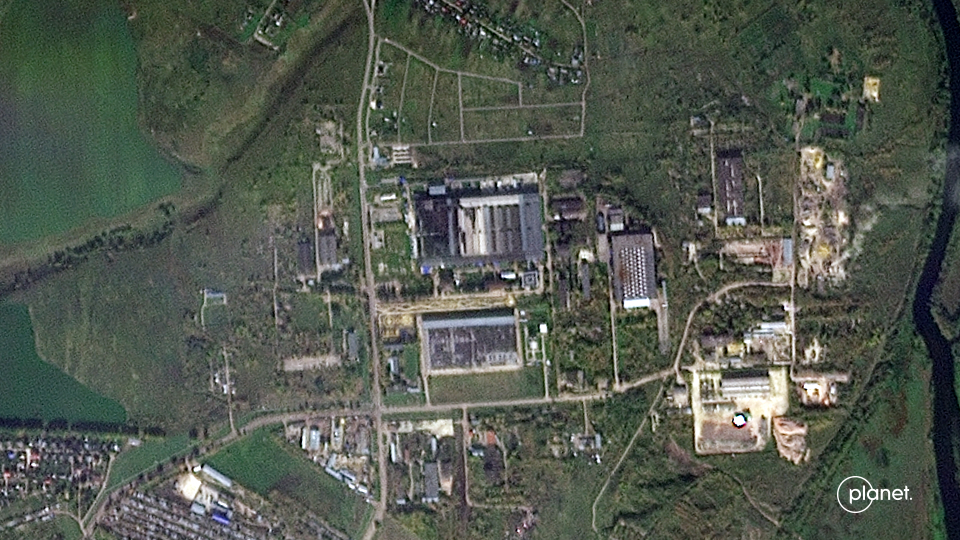
Ukrainian drone strikes have knocked out two of five <a href="https://axiomcore.info/yandex-takes-a-second-data-center-hit-in-48-hours/" title="Yandex Takes a Second Data Center Hit in 48 Hours”>data centers belonging to the Russian tech giant Yandex. The damage has left Yandex, known as “Russia’s Google” because it operates the country’s most popular search engine, struggling to maintain its AI chatbot and other online services.
The Ukrainian drones struck Yandex data centers in the Sasovo and Kaluga regions of Russia on October 8 and October 9 Those actions came as a direct response to a Russian drone strike campaign targeting Ukraine’s data centers, which has disrupted mobile phone and Internet services for thousands of Ukrainians since late September
“We continue to respond to Russia’s attacks on Ukraine, and we’re doing so with high precision,” said Ukrainian President Volodymyr Zelenskyy in a post on X. “Another data center was hit as well—our symmetrical response.”
The Ukrainian company Firepoint said its FP-1 one-way attack drones were involved in the latest strike on the Kaluga data center that is Yandex’s largest such facility, Reuters reported. The first Ukrainian attack targeted Yandex’s Sasovo data center that houses two of the company’s three supercomputers used for training the company’s YandexGPT AI model.
Yandex said no employees were hurt but acknowledged disruptions to some services. Russian users reported problems accessing media websites and popular apps for the Ivi video streaming platform, the digital banking service T-Bank and the state-owned Russian Railways, according to the independent Russian news publication Meduza.
Other impacted Russian services included a dating app, a real estate aggregator, a self-publishing book platform and the website of the most successful professional soccer club in the Russian Premier League
Targeting data centers is just the latest example of them becoming wartime targets in 2026. After the United States and Israel attacked Iran in February, Iranian drones knocked out multiple Amazon data centers in Bahrain and the United Arab Emirates.
But Russia has been regularly launching mass missile and drone attacks against Ukraine’s cities, targeting power grid infrastructure, transportation hubs and even residential apartment buildings since Russian President Vladimir Putin first launched his full-scale invasion of Ukraine in February 2022.
Ukraine has recently been grappling with a shortage of interceptor weapons capable of shooting down Russian missiles and jet-powered drones. But the Ukrainian military has also gradually ramped up its own medium-range and long-range drone strike campaign in response to Russian attacks.
Ukraine’s drone strikes have focused on Russian military bases and supply lines, Russian-linked shipping in the Sea of Azov and Black Sea, and Russian energy infrastructure such as oil refineries. In the summer of 2026, Ukraine also targeted multiple warehouses belonging to the Russian companies Wildberries and Ozon, which are Russia’s Amazon equivalents.
In a sign of the potentially widening war, coordinated aerial and sea drone strikes sank two commercial ships in the Black Sea within the exclusive economic zones of NATO member countries Romania and Bulgaria on October 5 and October 6. Ukraine’s president Zelenskyy attributed those attacks to Russia.
Jeremy HsuTech Reporter
Jeremy HsuTech Reporter
Jeremy Hsu is a reporter exploring a wide range of topics across deep tech and AI. He has previously written for New Scientist, Scientific American, IEEE Spectrum, Wired, Undark Magazine and MIT Tech Review, among many other publications, about topics such as deepfakes, data centers, drones, battery tech, robotics, and GPS jamming. He also has a Master of Arts in Journalism from NYU, and a bachelor’s degree from University of Pennsylvania in History and Sociology of Science, with a minor in English.
