

• Halloween frights:In the battle for control of Congress, challenges lurk in the shadows for both parties: Democrats will hope a GOP surge on Election Day doesn’t overwhelm their early vote advantage, while Republicans are warily watching how independents will break.
• Michigan divisions:As a rift grows between Senate nominee Abdul El-Sayed and his former Democratic primary rival Haley Stevens, GOP candidate Mike Rogers said Stevens was welcome to join him at campaign events.
• Final stretch for Trump: President Donald Trump will campaign virtually today. He reinstated rallies in Iowa and Kansas on Sunday, but has complained that his voice is wearing down and said he’s not sure in-person events will make a difference.
• Legal battle in Alaska:Democratic nominee Mary Peltola remains defiant as federal and state investigations ramp up over an alleged scheme to confuse voters on the Alaska Senate ballot.
Updates
Texas isn’t used to being a battleground state, but this election cycle it is one with closely watched competitive races across the state.
CNN’s Ed Lavandera reports on the races we’re watching this midterm cycle in the Lone Star State:
In 2026, Texas becomes a battleground state
CNN’s Ed Lavandera reports on the surprisingly close Senate race in Texas, a state Democrats haven’t won in over 30 years.
Turning Point USA continues to train volunteers in New Hampshire with just hours to go until Election Day.
Tyler Bowyer, the chief operating officer for Turning Point, postedin a video on X Saturday, saying that the organization is “injecting hundreds and hundreds and hundreds of staff” into the field this weekend. He also noted that the organization is hosting multiple trainings today. “We got to get John Sununu elected on Tuesday, do the work,” Bowyer added, plugging Republican Senate nominee John E. Sununu.
Sununu is in a tight race against Democratic Rep. Chris Pappas, a seat that could determine control of the Senate in this year’s midterm elections.
New Hampshire appears to have become a centerpiece of Turning Point Action’s midterm work, according to online posts from its activists and political observers in the Granite State. The state is part of the organization’s Chase the Ballot initiative, including “Commit 100,” which will “help chase voters in person.”
Voters cast their ballots at a polling station in New York on October 24.
As candidates hold a flurry of closing campaign events across the country, more than 50 million Americans havealready hit the voting booths or mailed in their selectionsbefore Tuesday’s election.
President Donald Trump has held rallies nearly every day this month to garner Republican support. After a pit stop at his golf course this morning in Daytona Beach, Florida, he will hold six telerallies this afternoon before heading to Iowa and Kansas on Sunday.
Here’s what else you should know:
Ghosts of elections past: Each party is parsing early voter data. Democrats will hope to maintain enough of an early advantage to stave off potentially high GOP turnout on election night. Republicans, on the other hand, are wary of which direction independent voters might break.
Family fight: Republican Senate candidate Mike Rogers told reporters he would welcome Democratic Rep. Haley Stevens on the campaign trail in Michigan, after Democratic nominee Abdul El-Sayed’s campaign reportedly asked his former primary opponent not to come to his events. Asked whether he would call Stevens, Rogers said he doesn’t want to “get in the middle of their party fight right now.” The Democratic rift centers in part on a controversial ad about foreign aid for Israel.
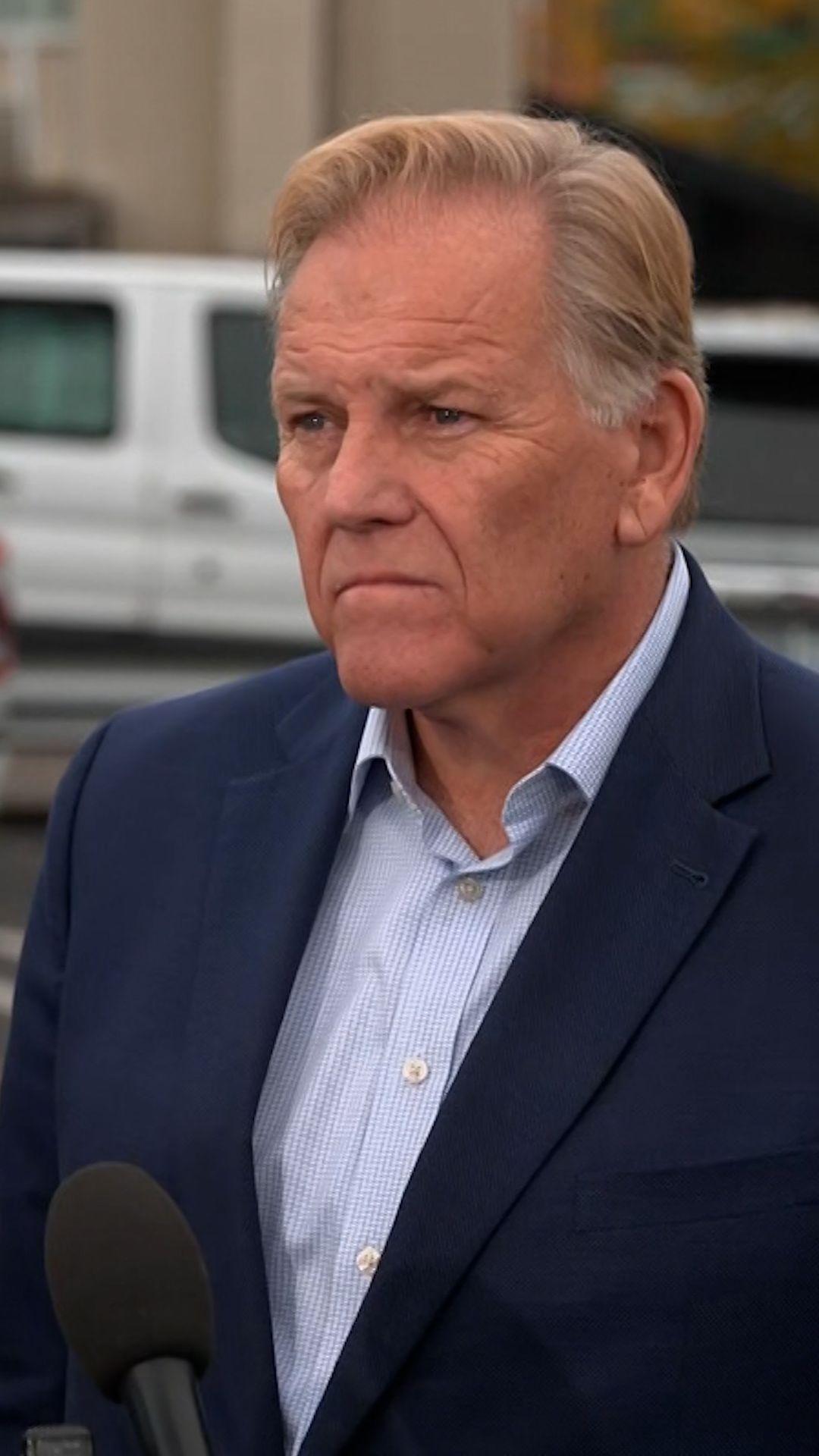
Mike Rogers says he’d welcome Haley Stevens on campaign trail
Michigan GOP Senate nominee Mike Rogers says he would welcome Democratic Rep. Haley Stevens at his campaign events, after Abdul El-Sayed asked her not to join him on the trail amid disagreements over her support for Israel and the war in Gaza.
Legal battles: The Justice Department will probably bring the California mail-in ballot case to the Supreme Court, Acting Deputy Attorney General Trent McCotter said Saturday. Meanwhile, there have been new court filings today in Alaska, where federal and state investigations are intensifying around an alleged Democratic scheme to recruit a spoiler Senate candidate. A Justice Department lawsuit seeks to potentially block the certification of the race’s outcome if GOP Sen. Dan Sullivan loses.
Big bets in Texas: Someone bet $500,000 on Texas Gov. Greg Abbott to win reelection — days after a separate $500,000 bet backing the incumbent Republican.
CNN’s Ethan Cohen, Kit Maher, Nicky Robertson, Marshall Cohen and Rebekah Riess contributed to this report.
A voters fill out his ballot during early voting in Minneapolis on Wednesday.
More than 50 million Americans have already voted with most of the last weekend before Election Day still to play out.
That’s according to data collected from 47 states and the District of Columbia by CNN, the Associated Press and Catalist, a company that provides data, analytics and other services to Democrats, academics and nonprofit issue-advocacy organizations and is giving insights into who is voting before Election Day.
About 57 million pre-election ballots were cast in 2022, meaning the count is about 87% of the total pre-election turnout from the last midterm.
Texas leads all states with more than 7.4 million ballots cast, according to data from the Secretary of State. Early voting wrapped up there Friday but the turnout number will increase as counties report their final data.
Gov. Greg Abbott speaks to supporters during a campaign rally in Montgomery, Texas on Wednesday.
Someone bet $500,000 on Texas Gov. Greg Abbott to win reelection — days after a separate $500,000 bet backing the incumbent Republican.
It’s unclear if the trades on Kalshi’s prediction market are connected. Kalshi records indicate that both bets came from institutional traders, who are likely hedging how the election outcome could affect their investments which tracks prediction markets
Abbott is running against Democrat Gina Hinojosa in a what could be his most competitive race since 2014, when he was first elected governor.
The latest trade came at 64 cents per share, meaning the trader gave Abbott a 64% chance to win. If Abbott prevails, this trade would bring in about $281,000 in profit.
Election-betting on prediction markets like Kalshi and Polymarket has become more popular than ever. There has already been more than $1.4 billion in midterms-related trading volume this year.
CNN has a partnership with Kalshi and uses its data to cover major events, including elections. CNN employees are prohibited from using prediction markets.
Acting Deputy Attorney General Trent McCotter speaks during a news conference in Washington, DC, on September 22.
Acting Deputy Attorney General Trent McCotter said Saturday that the Justice Department will probably bring the California mail-in ballot case to the Supreme Court as the Trump administration ramps up its scrutiny of the midterm elections.
“We’ve already taken it up on appeal. We’re looking at whether to go to the Supreme Court right now. That decision is being made probably as we speak,” McCotter said on Fox News.
“We’ve gone this far,” he added. “I hesitate to give a final answer, but I think probably the Supreme Court’s next on this one.”
Asked if this would happen before Tuesday, McCotter said: “If we file something, it would definitely be before that.”
“Remember, in California, they keep counting and keep receiving ballots well after Election Day, and so even after election, the case isn’t moot necessarily. They’re still going to be receiving ballots from people that we think are in fact not allowed to vote,” he said.
Afederal judge said Wednesdaythat the Trump administration’s request to segretate as many as 20,000 ballots in California to vet citizenship would “create a chilling effect on election workers and voters alike, and discount the votes of United States citizens.”
Michigan Senate candidate Mike Rogers speaks to voters in Grand Rapids, Michigan on Friday.
Mike Rogers, the Republican former congressman running for Senate in Michigan, told reporters this morning that he would welcome Democratic Rep. Haley Stevens on the campaign trail, after Democratic nominee Abdul El-Sayed reportedly asked her to skip joining him on the trail over the next few days.
This comes after Stevens, who was El-Sayed’s opponent in a hard-fought primary, called on her fellow Democrat to forcefully condemn an outside group’s advertisement that blames Americans’ cost-of-living struggles on US foreign aid for Israel.
When asked if he thought there was any scenario where Stevens would campaign with him, Rogers said he hadn’t asked her.
Asked whether he would call her, Rogers said he doesn’t want to “get in the middle of their party fight right now.”
Outreach continues:The GOP nominee spent this morning in South Detroit having breakfast with Rev. Dr. Charles Williams II and another pastor, as he continues to court Black voters in Michigan.
“This can’t be left or right at a time like this. The city needs a little extra attention,” Rogers said after their meeting.
Williams has already voted and endorsed El-Sayed, but emphasized that it’s important to have conversations across the aisle.
“I’m here to show leadership, to let people understand that Blacks have issues. We cannot play party politics with our Black issues,” Williams told reporters. “I was glad he called and reached out and said, ‘Hey — I want to hear about your issues.’”
On this spookiest day of the year, the most optimistic Democrats may be haunted by the ghosts of 2022.
Pre-election voting this year has largely been good for Democrats. But it hasn’t been significantly better than it was in the last midterm, and if Election Day turnout looks like it did that year, the final outcome might fall short of a Democratic wave.
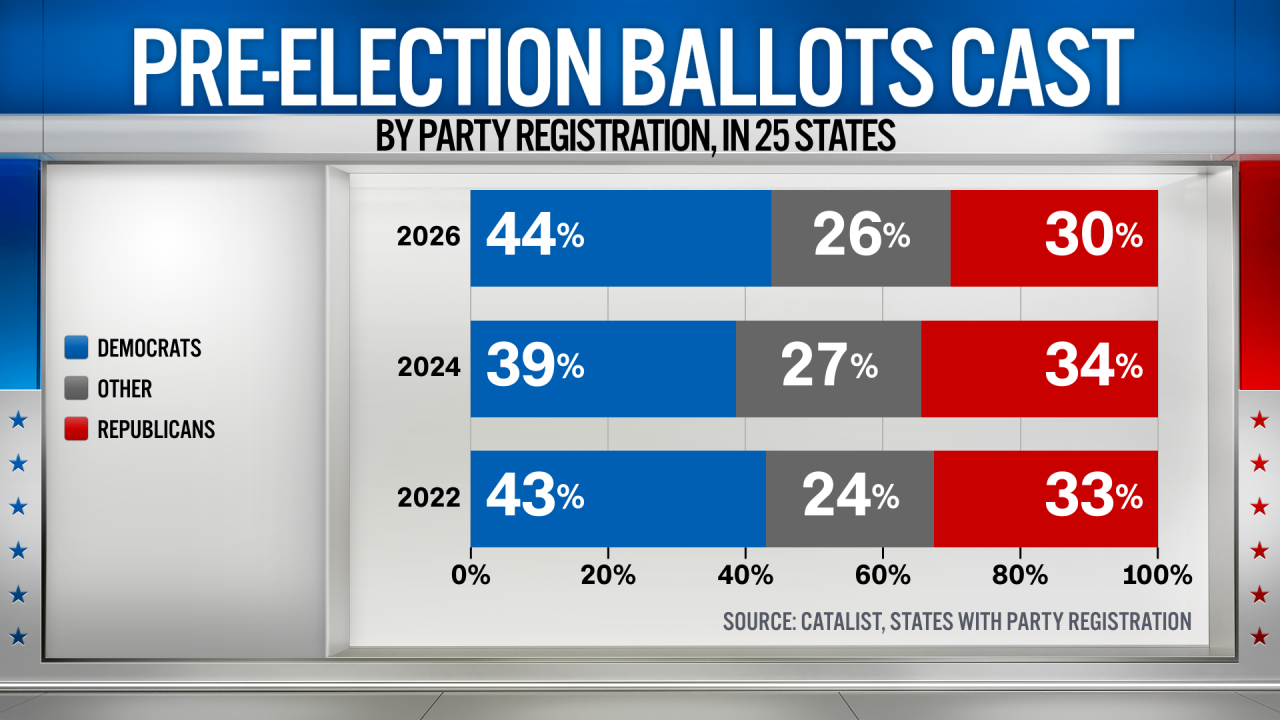
Across 25 states with party registration for which Catalist has comparable data, registered Democrats have a nearly 14-point lead over registered Republicans in the share of pre-election voters so far. But it’s only about three points wider than it was at this point in 2022.
That pre-election performance was enough to help stave off a GOP rout, but Republican voters turned out on Election Day as the party won a narrow majority in the House and Democrats picked up a seat in the Senate, despite Democratic President Joe Biden’s unpopularity at the time. The CNN Poll of Polls at that time found him deeply underwater, but not as negative as President Donald Trump’s ratings now.
Sixty percent of voters who described themselves as Republicans cast their ballots on Election Day, according to the CNN Exit Poll, compared to just 42% of Democrats.
Polling this year has consistentlysuggestedDemocrats have a wide advantage in enthusiasm about voting, with early voting trends supporting that finding so far. The size of GOP turnout on Election Day, though, could be decisive.
If Republicans are waiting to vote on Election Day, Tuesday night could be an underwhelming trick for Democrats, especially because so many of the Senate races they’re hoping to win are in Republican-leaning states.
But if the turnout breaks look more like they did two years ago, when only 43% of Republicans voted on Election Day itself, Democrats may head home with a bag full of treats.
President Donald Trump speaks at a rally in Daytona Beach, Florida on Friday.
President Donald Trump arrived at his golf course in Palm Beach, Florida, this morning after holding a rally in Daytona Beach last night and is set to hold six telerallies this afternoon, as the midterm campaign heads into the final stretch.
Trump has held midterm rallies nearly every day this month to boost Republican turnout.
On Thursday, Trump canceled rallies in Iowa and Kansas but CNN reported that the president fumed about the coverage of the cancellations and demanded they be put back on his schedule. Both events are now scheduled for Sunday.
Trump last night said he had thought the Daytona Beach rally would be his “last one,” before receiving calls from people in Iowa and Kansas to revive the in-person rallies.
“On Sunday, while you’re all watching football, I’ll be traveling in a very beautiful airplane,” Trump said.
Republicans are lagging Democrats in early voting so far, but the independent vote lurking in the shadows could give them another reason for fear this Halloween.
Across 25 states with party registration for which Catalist has comparable data, more than a quarter of voters are not registered with either major party. That’s about two points higher than it was at this point in 2022, and less than a point off 2024.
If Democratic voters are more interested in turning out so far than Republicans, then it follows that voters so far who aren’t registered with either party would also be more likely to be Democratic-leaning. Polling this year backs that up, largely finding independents breaking Democratic.
This year, according to state voter data, unaffiliated pre-election voters in North Carolina are more likely to be Black or Latino than they were at this point in either of the last two elections, and are more likely to be younger than they were in the last midterm. All those groups are generally more likely to be Democratic leaning. North Carolina is a highly competitive state, but Democrat Roy Cooper is widely expected to win the state’s Senate race next week, so the trend could be especially pronounced here.
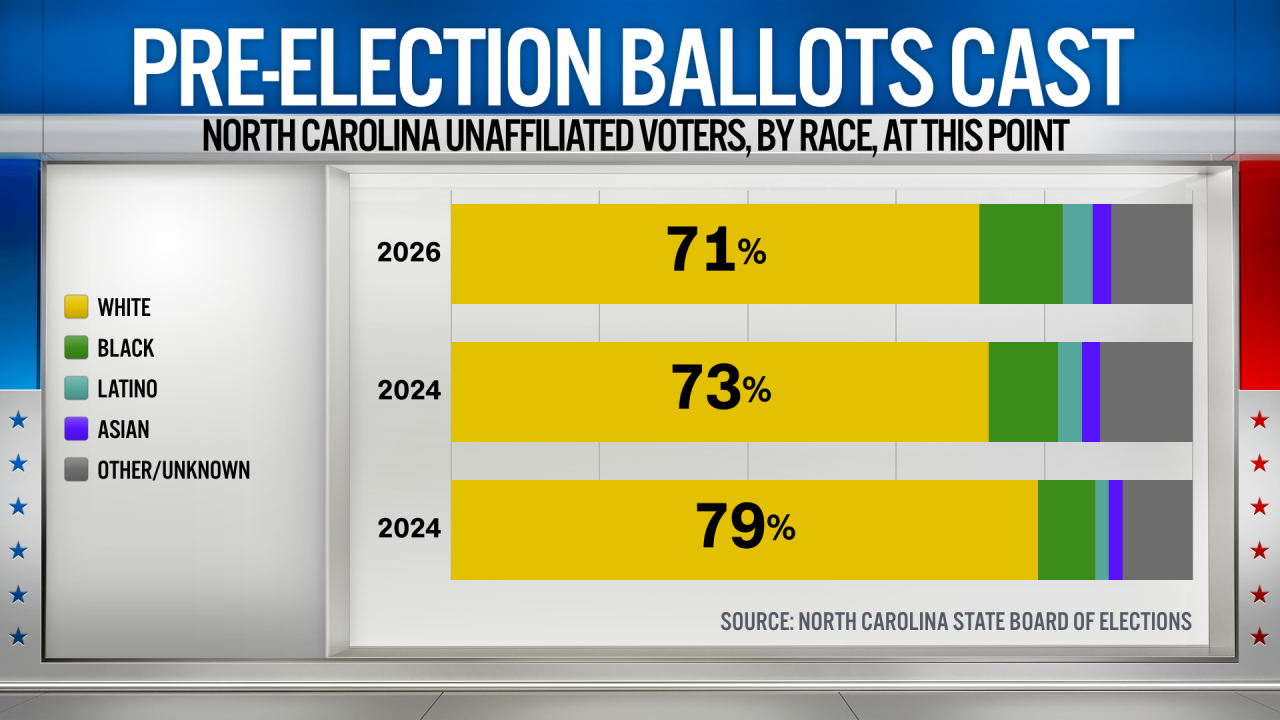
And all of that is before getting to polling data which has consistently shown Democrats outperforming Republicans among independent voters. In CNN’s four Senate polls this week, the Democratic candidates held leads among independent voters ranging from eight points in Maine to 29 points in Kansas, though with large shares still unsure of which candidate they would back.
Even though party affiliation isn’t a perfect proxy for vote choice, if these trends hold up, the wide partisan gap apparent in the pre-election vote data might wind up understating the Republican challenge heading into Election Day.
One model forecast for early next week.
A storm headed for the central United States on Election Day could affect voter turnout in key races across the region.
The beginnings of our storm are just off the West Coast and will cross into the US Saturday night. It will funnel in abundant moisture from the tropical Pacific, setting up a serious flooding threat in the Southwest this weekend before it brings soggy weather to the central states for Election Day.
Heavy rain is expected to fall over the Four Corners states of Arizona, New Mexico, Utah and Colorado on Sunday into Monday, and could bring seriousflash flooding, before the system marches into the central US by Election Day.
Read more about the Election Day forecast
The state of Alaska has responded to the Department of Justice’s motion for an expedited preliminary injunction in their “preservation lawsuit” seeking to delay certification if GOP Sen. Dan Sullivan loses the Senate race in the state. The state argues no court order “either before or after the election is needed” to preserve ballots.
Alaska’s Republican-led elections office has been pressing the court to dismiss the case quickly, arguing that lawsuit seeks to sow “doubt” and will “cast a cloud over” the Senate election contest.
“Neither expedited consideration nor a preliminary injunction is necessary to preserve ballots,” the state’s response to the DOJ motion says, explaining that the Division of Elections of the State of Alaska doesn’t destroy federal election ballots on Election Day, but preserves them for 22 months afterward.
The response asking the court to deny the DOJ request also noted “the ballots (whether segregated or not) will not reveal any voter’s reasons for voting for Daniel J.”
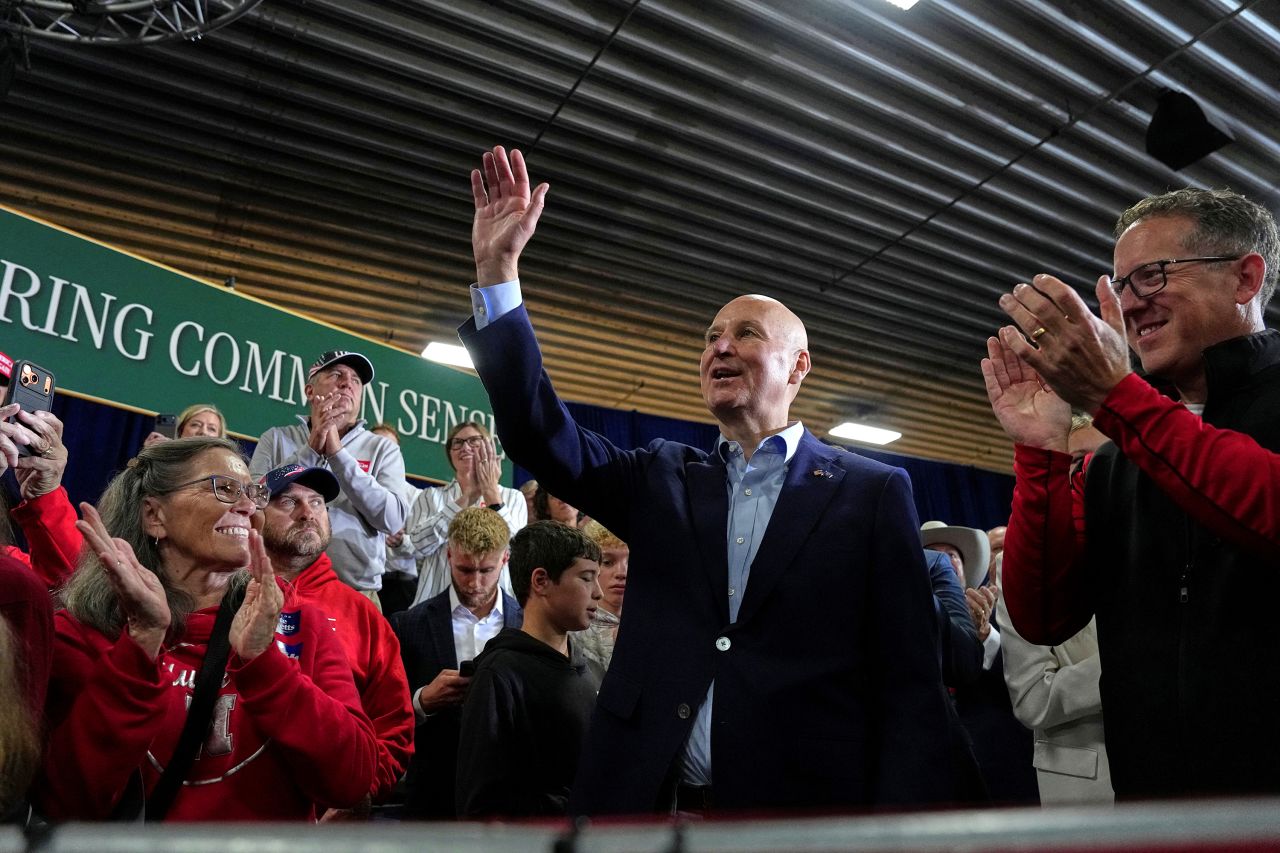
Sen. Pete Ricketts waves to supporters during a campaign rally in North Platte, Nebraska, on October 22.
Incumbent Republican Sen. Pete Ricketts has the lead in the Senate race in Nebraska, aNew York Times/Siena poll released today finds.
The poll, one of the first nonpartisan surveys of the race this fall, finds 49% of likely voters backing Ricketts, with 43% backing his opponent Dan Osborn, an independent.
Most voters in the state see Osborn as aligned with the Democratic Party: 55% say he’s more similar to the Democrats and just 4% that he’s more similar to Republicans, with about a third seeing him as more of an independent than someone aligned with either party.
Nebraska’s political environment is also less challenging for the GOP than in many other states this year.
Likely voters there are about evenly split in their ratings of President Donald Trump’s job performance — 47% approve, 49% disapprove — and while ratings for both political parties are negative, voters are far more likely to express dissatisfaction with the Democrats.
Some background: The New York Times/Siena poll in Nebraska was conducted using live telephone interviews of respondents selected from a voter file, and surveyed 809 likely voters from Oct. 23-29. Results among the full sample have a +/-4.0 percentage point margin of sampling error.
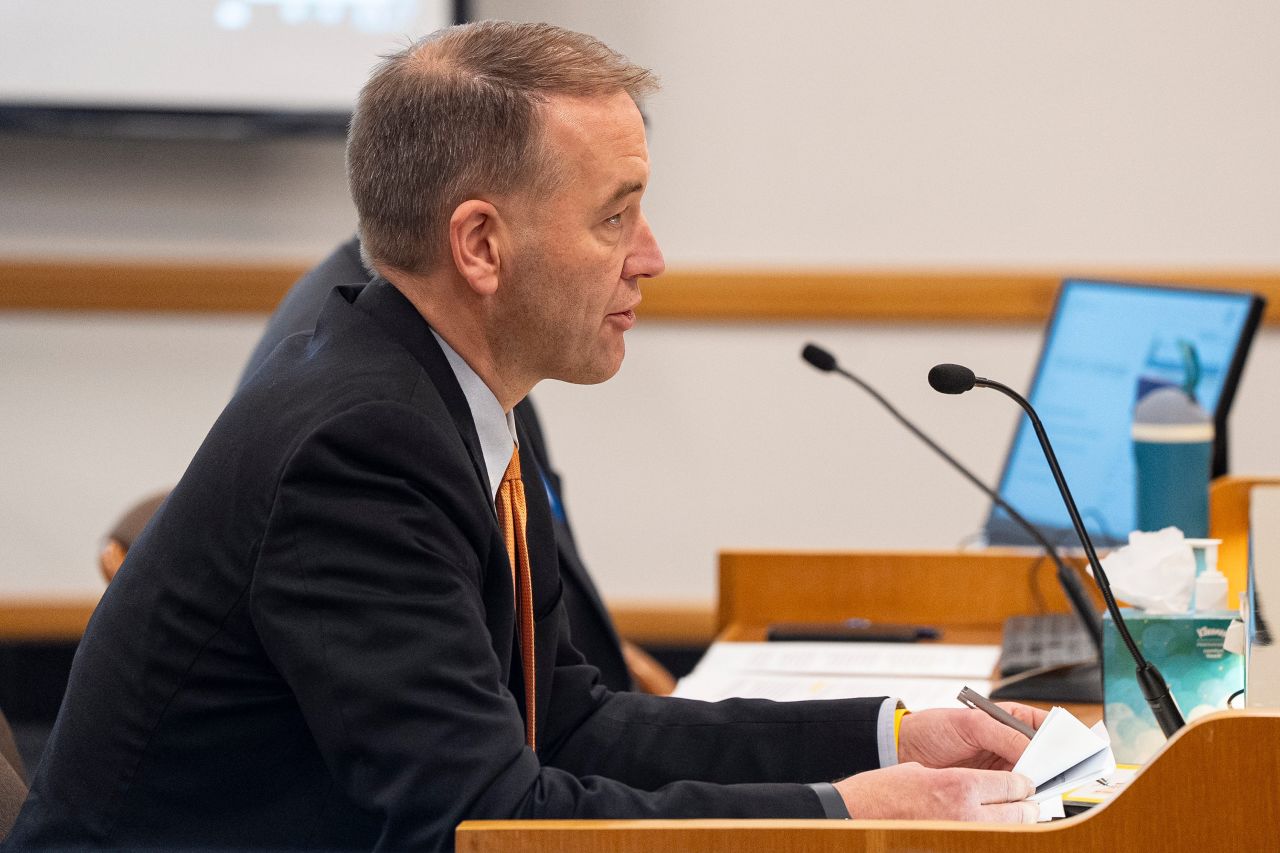
Oregon Secretary of State Tobias Read speaks during a meeting in Salem, Oregon, on January 13.
Oregon Democratic Secretary of State Tobias Read on Friday responded to a letter from the Justice Department on preserving election records, telling acting Deputy Attorney General R. Trent McCotter to “read the Constitution,” after McCotter’s letter misspelled his last name as “Reed.”
McCotter cited a congressional statute to “remind” Read, in a letter Thursday, that he must preserve ballots, voter registration forms and other election records for 22 months. The letter comes as the federal government continues its scrutiny of the midterm elections.
Read said in a written response, “As secretaries of state across the country know, effective election administration requires professionalism, competency and attention to detail. It is in that spirit that I will point out to you that my name is spelled R-E-A-D, as in ‘read the Constitution.’”
In a statement to CNN, Read said, “In Oregon, we take our responsibility to protect free, fair American elections seriously. We follow the law and the Constitution. The federal government should do the same.”
The Justice Department told CNN in a statement, “Election integrity is, and remains, a top priority. In order to bring unlawful voting and registration cases, the Department relies on state voting records. We are simply reminding them of their obligation under federal law to preserve these documents.”
The Justice Department has increasingly put pressure on election officials across the country, particularly to combat noncitizen voting. On Friday, a federal judge imposed a sweeping emergency order that halted the DOJ’s efforts and blocked it from threatening election officials with criminal prosecution.
This post has been updated.
President Donald Trump leaned into his blistering rhetoric against Democratic Michigan Senate candidate Abdul El-Sayed at his rally in Florida yesterday, urging voters to “send him back to where he came from,” despite El-Sayed being born and raised in Michigan.
If you’re catching up on last night’s campaign events, you can watch the moment below:
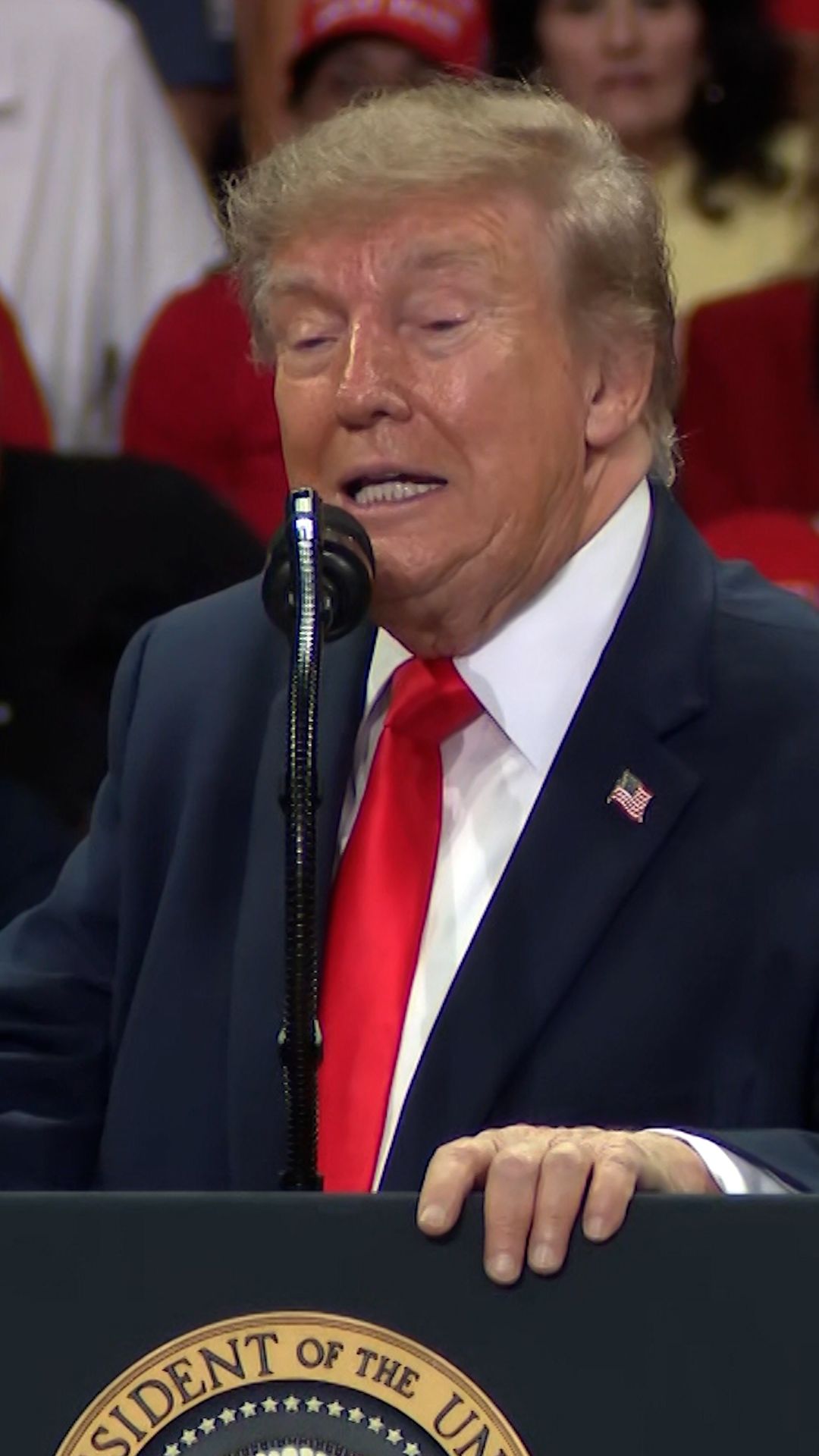
Trump continues attacks on Abdul El-Sayed
President Donald Trump continued his attacks on Democratic Michigan Senate candidate Abdul El-Sayed at a Florida rally on Friday, urging voters to “send him back to where he came from,” despite El-Sayed being born and raised in Michigan.
In an abrupt about-turn, President Donald Trump has reinstated two upcoming rally appearances in Kansas and Iowa tomorrow, after previously scrapping them in favor of telerallies.
Earlier this month, Trump said he was “working like a dog” to defend the Republican majority in the upcoming midterm elections. Since the beginning of October, the president has held at least 26 rallies, the most recent of which was in Daytona Beach, Florida yesterday.
Trump said his voice is operating at “about 49.2%” as he talks about participating in upcoming rallies in Iowa and Kansas
1:08• talks about participating in upcoming rallies in Iowa and Kansas
1:08
Trump started October at a rally in Durant, Oklahoma, going on to attend a separate event in Dallas, Texas later that day, where he described Texas Republican Senate candidate Ken Paxton as “a pain in the ass.”
In the following days, the president spoke at rallies in Mobile, Alabama and Vandalia, Ohio. He then traveled to Grand Island in Nebraska, San Antonio in Texas, Syracuse in New York and Clarksville in Tennessee the following week.
Trump drew criticism in Grand Island when he appeared to suggest Iran could “take out” Los Angeles or San Diego. He then appeared to clarify those remarks in San Antonio by adding: “We’re not going to let that happen.”
In mid-October, the president spoke at five rallies in red states in one week, railing against Somali and Haitian communities, making comments about the appearance of those running for election, and suggesting that he could do anything and not lose MAGA support.
In keeping with his many pledges to voters if Republicans are successful in the midterms, Trump has promised a $100 million investment in a pharmaceutical plant in Kentucky if the GOP holds onto Congress, as well as a $15 billion steel mill in Iowa and a “massive” $4.2 billion Audi plant in Georgia.
Trump also told Ohio voters on Wednesday that he would “consider” putting the new US Space Academy in their state if Republican incumbent Sen. Jon Husted wins there.
In South Carolina on Thursday, Trump claimed he was working harder on this year’s midterm elections than any president before him.

Alaska Senate candidate Dan J. Sullivan stands in front of a welcome sign near downtown Petersburg, Alaska, on July 3.
As the Justice Department dramatically accelerates a criminal probe into whether Alaska Democrats sought to confuse voters by recruiting a Senate candidate intended to siphon votes from the Republican, the FBI on Friday began reaching out to donors of Dan J. Sullivan asking about potential deception, according to the Associated Press.
An Anchorage-based FBI agent visited a boat dealership in Petersburg, a small fishing community accessible only by air or water where the candidate lives. The agent left a business card for Charles Flint, who told the AP he has known Dan J. Sullivan for years as a respected teacher and musician.
Flint contributed $500 over the summer to what he considered a long-shot campaign, saying he knew Dan J. Sullivan would have expenses and respected him for “throwing his hat in the ring.”
Flint said the FBI agent asked his son, who works at the dealership, whether Flint felt he had been “misled” about which candidate he was supporting.
“I don’t feel like I’ve been misled at all,” Flint, who has been out of town, told the AP in a telephone interview, adding he had no intention of calling the agent and would “let him waste his time trying to track me down.”
“I don’t think there’s any confusion,” he said, adding he intends to rank Democrat Mary Peltola first on his ballot, followed by Dan J. Sullivan. “Everybody knows who the incumbent is.”
As a Justice Department investigation scrutinizes whether Democrats recruited a Senate candidate to confuse Alaska voters, a big-money effort propping up a different fringe name on the ballot could also hurt Republicans in that race – and in another pivotal contest in Ohio.
Newly created political action committees linked to a Wisconsin operative with a history of election-law violations are spending millions to attack Republican incumbents in Alaska and Ohio from the right and to promote longshot conservative challengers, a CNN investigation found.
Both races could help determine control of the Senate.
Who is financing the spending in the final days before the elections remains unclear. But the groups allshare a common link: Thomas Datwyler, a Wisconsin political consultant whohas faced a litany of campaign finance complaints around the country.
The groups’ spending could draw new federal scrutiny if Democrat Mary Peltola succeeds in unseating Republican Sen. Daniel S. Sullivan.
You can read more on this, here.
After an about-turn on whether or not he would hold any more rallies in the run up to Election Day, President Donald Trump is set to participate in several telerallies today, ahead of two in person rallies tomorrow.
A event scheduled to take place in Kansas today was scrapped earlier this week, though it will now be going ahead tomorrow.
Here’s a look at other recent midterms developments:
- Michigan Democratic Senate nominee Abdul El-Sayed is brushing off a call from his former primary rival, Rep. Haley Stevens, to denounce a controversial advertisement criticizing the US’ foreign aid for Israel.
- A federal judge imposed a sweeping emergency order halting recent Trump administration tactics to pressure election officials. While the order is in place, the Justice Department and the Department of Homeland Security cannot demand that election officials in any state segregate ballots, purge voters from voter rolls, or halt ballot processing.
- The Alaska Democratic Party and several state representatives filed a lawsuit against the Division of Elections Thursday, claiming it failed to open numerous absentee early in-person voting locations.
- In the final weeks of Ohio GOP Rep. Max Miller’s midterms campaigning, the National Republicans, who just months ago were trying to convince Miller to exit the race, have poured millions into it as Miller’s fundraising has lagged.
- Pope Leo submitted a mail-in ballot for the US midterms yesterday, becoming the first pope to vote in a US election and likely the first to vote in a secular democratic election.
CNN’s Eric Bradner, Tierney Sneed, Isa Mudannayake, Kyung Lah, Lauren Fox, Morgan Rimmer and Christopher Lamb contributed to this reporting.
Alaska is at the center of a roiling political controversy this week over how a second Dan Sullivan ended up on the state’s Senate ballot. It has sparked lawsuits, criminal investigations and threats to block certification of the election if incumbent GOP Sen. Dan Sullivan is defeated.
The uproar about the Alaska Senate race could ratchet up to 11 if control of the Senate comes down to who wins in the state, one that election officials and experts say is unlike any other when it comes to voting. That’s because it might take two weeks before a winner can be determined.
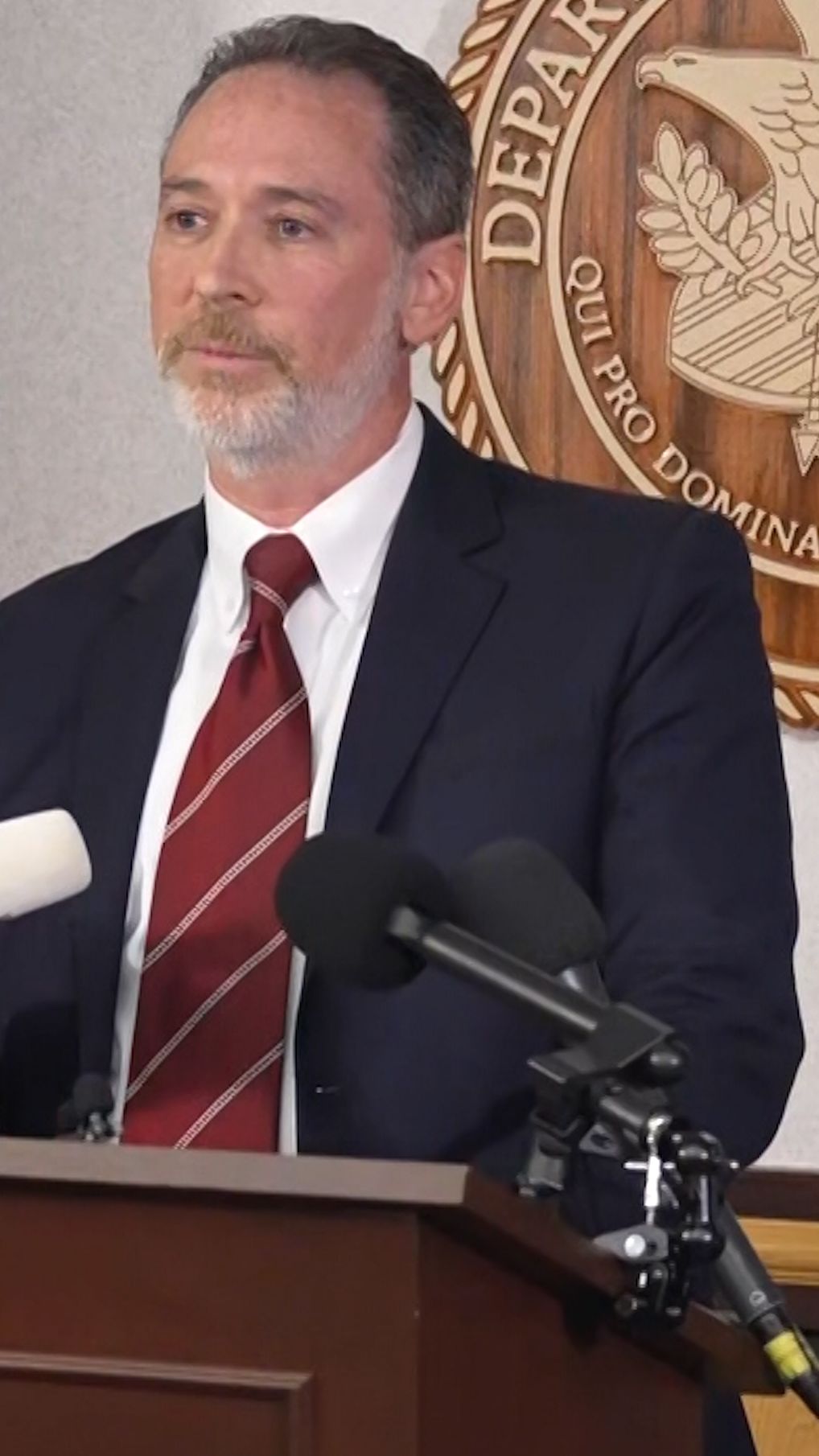
Top Alaska prosecutor on Senate race investigation
The top federal prosecutor in Alaska said Friday that he has not had any interaction with the White House about the ongoing criminal investigation into the state’s Senate race as he’s been on the case for roughly 24 hours. CNN reported Thursday that Michael Heyman recused himself because he was up for a federal judgeship, which he ultimately was not nominated for. His recusal was rescinded by DOJ leadership. CNN’s Kyung Lah reports.
Alaska has long been one of the slowest states for reporting election results. Why this is so:
Geography:The state is massive, with residents in far-flung areas where ballots have to be flown in to be counted because communities aren’t on the state’s roadway network. That remoteness is why the state gives mail ballot deadlines of 10 and 15 days after the election, so long as they are postmarked by Election Day.
Ranked choice voting:Alaska uses a system called ranked choice voting to count votes, a process where results won’t be finalized until after that 15-day period if no candidate receives 50% of the vote on the first ballot. The state waits for the 15-day deadline to run out before running the ranked choice tabulation. How it works: The votes of the fourth-place finisher are distributed among the top three vote getters, based on how voters rank the four candidates on the ballot. Then the votes of the third-place finisher are distributed to the top two vote-getters, which will put a candidate above the 50% threshold.
