
Press Contact:
Abby
Abazorius
Email:abbya@mit.edu
Phone:617-253-2709
MIT News Office
Close

Caption:
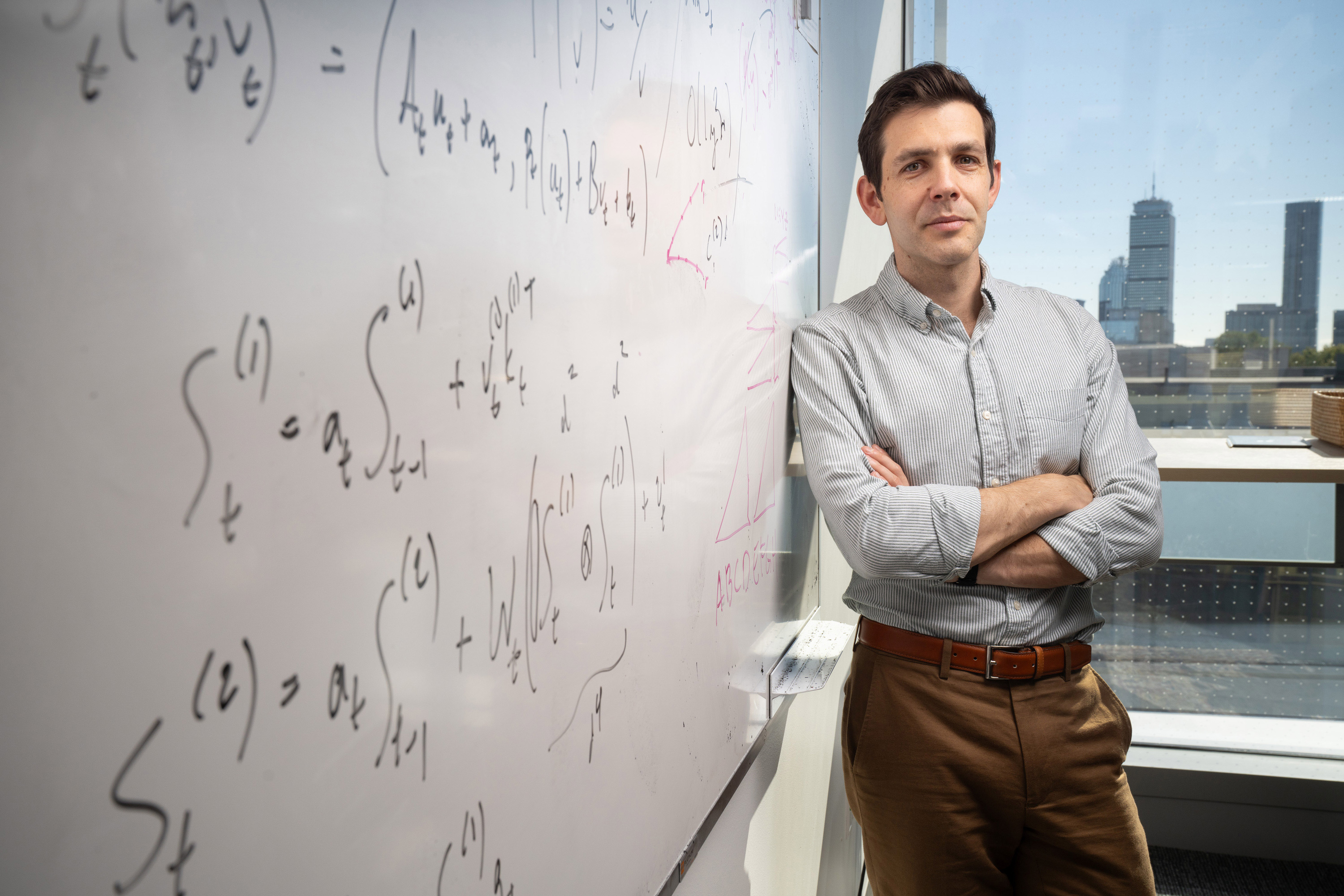
“Rather than needing to use all these external tools to try and understand what is going on under the hood, maybe we can train models to talk about themselves in a way that is accurate,” says Jacob Andreas.
Credits:
Credit: Bryce Vickmark
When deploying deep learning models in high-stakes scenarios, researchers would like to understand how they work. Today, this requires unraveling an enormously complex network of internal processing nodes to understand what the model knows and how it will likely behave in practice.
Jacob Andreas would rather have the models explain themselves.
The newly tenured associate professor develops techniques that enable artificial intelligence models to communicate accurately about what they learned from their training data, in language humans can understand.
“Rather than needing to use all these external tools to try and understand what is going on under the hood, maybe we can train models to talk about themselves in a way that is accurate,” says Andreas, an associate professor in the Department of Electrical Engineering and Computer Science (EECS) and a member of the Computer Science and Artificial Intelligence Laboratory (CSAIL).
<img src="http://axiomcore.info/wp-content/uploads/2026/11/placeholder-news-article-image-gallery.jpg" alt="Jacob Andreas is pictured with graduate students (left to right) Alan Sun, Linlu Qiu, and Itamar Pres.”>
“I try to impress upon the students that having a really deep foundation in how all this technology works under the hood is the only way they are going to understand it, and will differentiate them in a world where everyone has access to a coding agent,” Andreas says.
Credit: Bryce Vickmark
Ultimately, he and his group want to help people design more accurate and robust deep-learning models that are better suited for their intended application.
“We used to debug systems just by looking at their parameters and figuring out whether they make sense or not. Now, we need ‘mind-reading tools’ that can take this really complicated neural computation and translate it for us because it is just not in a language that we, as humans, know how to speak,” he says.
Andreas’ fascination with language blossomed at a young age. As a child growing up in the San Francisco Bay Area, he was a voracious reader of any book he could get his hands on.
One such book, passed along to him by a family friend, contained a pivotal scene where the main character hacked into a computer system to save the day.
That piqued his interest in computers. A few years later, his father brought home a simple BASIC Engine that Andreas could run on their home computer, and he started immersing himself in the world of computer programming.
Andreas chose to major in computer science as an undergraduate at Columbia University but wasn’t sure if he wanted to pursue a career as a researcher, as a software engineer, or at a startup.
His friends signed up for research projects in faculty labs, so Andreas figured he would try that, too.
“I just blast emailed everyone in the computer science department who was working on anything vaguely AI-related, and the natural language processing faculty got back to me first. That is how I wound up in the field where I am now,” he says.
Working in the lab of Michael Collins, the Vikram S. Pandit Professor of Computer Science at Columbia University, Andreas completed an undergraduate thesis project on machine translation. His project involved adapting existing statistical techniques for representing the meaning of language into more powerful AI systems that could translate passages of text.
“I always felt like these deeper questions about how thought works or how to model the world were closer to the surface in language processing problems than in the other tasks that AI people were working on at the time,” he recalls.
He wanted to keep exploring deep questions, so Andreas enrolled in graduate school at the University of California at Berkeley to pursue a career as an academic researcher.
Before starting his PhD studies, he spent a year earning a master’s degree at Cambridge University in England. In that historic environment, he was inspired to contemplate the nature of language learning as he worked on computational translation problems.
Those studies fueled his research when he joined the lab of Berkeley professor of computer science Dan Klein.
Andreas began his studies at the time when neural networks were starting to take off. The field of natural language processing was making a seismic shift from statistical methods to this new world of deep learning.
Statistical methods utilize transparent, mathematical formulas to analyze text, while deep learning techniques use opaque algorithms to automatically learn complex meanings from massive amounts of text data.
“It was fun to be there as we made this transition to the modern toolkit, and learning and inventing all of that stuff when it was still new,” Andreas says.
He began collaborating with scientists in computer vision labs to tackle increasingly complex questions about language learning. Together, they designed AI systems that excelled at generating natural language by teaching those systems to “see” and understand the world around them.
“This was all super-exciting because there really hadn’t been a common set of tools for working with both language and vision data. Then, all of a sudden, neural networks gave us this common language,” he recalls.
He completed a thesis project on the use of neural module networks, which are small fragments of neural networks that perform specific tasks, like localizing objects or logical reasoning, in a larger AI system. But it was the more speculative projects he tackled alongside his thesis, like interpretability and creating natural language descriptions of an AI model’s internal states, that would drive the focus of his group at MIT.
After spending a year at the startup Semantic Machines (which spun out of his lab at Berkeley), Andreas joined the MIT faculty in 2019.
“It felt like this was a fantastic opportunity to be in the homeland of AI research and collaborate with all these amazing, established people, but also do something new and figure out what the modern era in machine learning was going to look like,” he says.
His group focuses on two main areas. First, they are studying the science of large language models to understand the algorithms these models deploy as they learn and process information.
The tools they develop help scientists and researchers better predict how a trained model will behave in the real world. For instance, one family of techniques they developed trains large language models to explain what is going on inside other neural networks using language a human could understand.
These techniques can assign a natural language description to every information-processing node in a massive neural network. For example, one such description might represent an individual node that identifies “patches of grass near animals” in input images.
“That work serves as a jumping off point for a bunch of higher-level questions we ask about how these models represent meaning,” he says.
On the other side, his team designs new algorithms for training machine-learning models, and for predicting how specific datasets or examples will affect different aspects of model behavior.
“We don’t have a good scientific theory of what is going to happen when you train a model on a particular dataset. This is a big challenge for the field right now,” he says.
The speed of AI advancement presents one of the biggest challenges his lab faces. The field seems to completely change every three to five years, Andreas says, forcing him to stay nimble and ready to learn something new.
That same dilemma carries over into the courses 6.461 and 6.861 (undergraduate and graduate Natural Language Processing), which Andreas co-teaches. He and his fellow instructors must redesign the course each year to keep up with the newest developments.
It’s also challenging to teach the technical pieces of machine learning in an era where every assignment could be completed by a large language model rather than a human pupil.
“I try to impress upon the students that having a really deep foundation in how all this technology works under the hood is the only way they are going to understand it, and will differentiate them in a world where everyone has access to a coding agent,” he says.
With so much change, it is difficult to predict where the field is headed next, Andreas says. He foresees that his group’s work on interpretability will become even more important for making advanced systems like AI agents safe enough to deploy in high-stakes situations.
This will be especially true as researchers design deep-learning models that can aid in scientific discovery. These models will be trained on troves of raw data from research labs that may not be well-understood by scientists yet.
“Figuring out how to enable these models to verbalize all of this hidden knowledge they have about things people have never written about explicitly will be a huge challenge and opportunity for people who work in machine learning,” he says.
In addition to tackling challenges in the lab, Andreas enjoys pushing himself as a hiker and backpacker. He has loved spending time in the outdoors since his childhood in California and goes on at least one or two backpacking trips each summer.
He and a colleague in the Department of Mathematics are working their way across all the 4,000-foot peaks in the White Mountains of New Hampshire, making slow but steady progress.
And now that he has earned tenure, Andreas is looking forward to getting back into an old hobby — singing in a chamber choir. He’s always enjoyed music and became enamored with chapel choirs and bell ringing during his time at Cambridge University.
