
BLOOMINGTON (25News Now) – Pearl Technology is an IT services and technology solutions provider in Central Illinois that has owned and operated its own <a href="https://axiomcore.info/dems-data-center-attack-in-critical-senate-race-hits-snag-when-money-trail-surfaces-jekyll-and/" title="Dem’s data center attack in critical Senate race hits snag when money trail surfaces: 'Jekyll-and”>data centers in Peoria and Bloomington for the last 13 years.
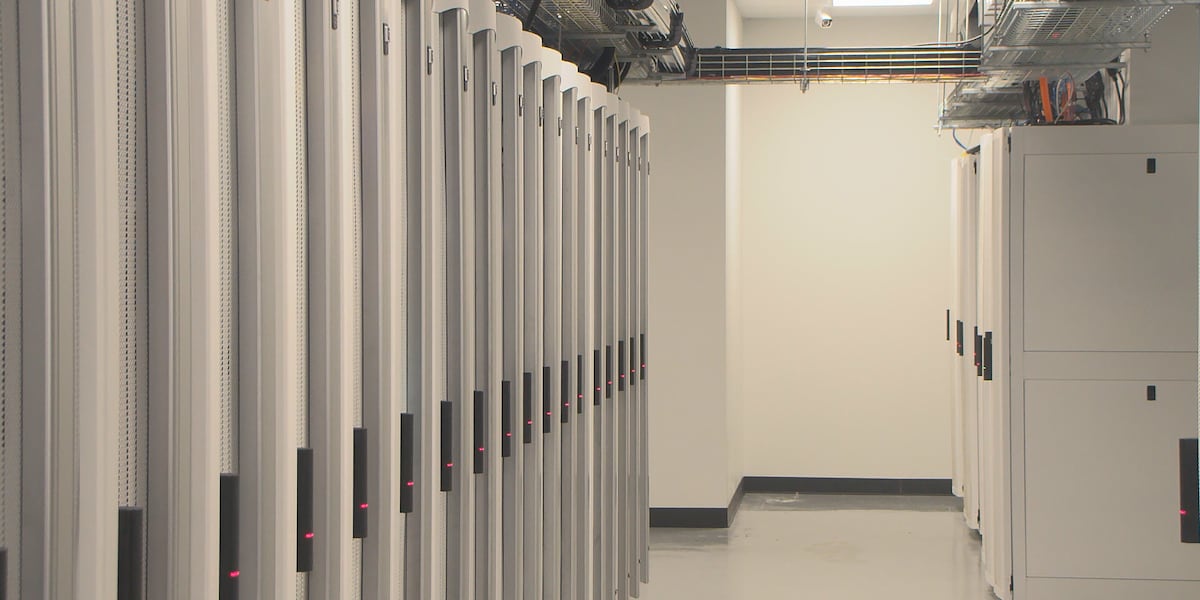
25News was given a tour of the company’s data center in Downtown Bloomington, which according to its leaders, operates around the clock to ensure the safety of sensitive information belonging to clients, including local small businesses, banks and hospitals.
Most large-scale data centers are known for producing a constant humming noise. However, outside Pearl Technology’s smaller, roughly 30,000-square-foot data center, it is silent.
Once you make it through the second set of doors, however, the humming from the data center starts to make its way through the walls.
Consuming roughly the same amount of energy as a grocery store during its peak season in the summer, the data center has a maximum power capacity of 2 megawatts. Through the security doors are 260 racks, with 80 of them currently storing data from Pearl Technology’s customers.
The data center’s second floor has room to expand to fit 200 more racks.
“What we have here is a layered approach for customers that want to have their data secure and accessible in the event of some sort of disaster or power failure throughout the city. Folks want to know that their critical infrastructure is safe and that’s what we do here,” said Pat Venditte, an account executive for Pearl Technology, speaking just slightly louder as he stood in front of the racks inside the data center.
Above the racks are carefully positioned thick wires carrying power from the mechanical room behind them. The power is then distributed to boxes above the racks, which provide the necessary amount to each one.
“Power comes into this room from the mechanical room, through these conduits and into this cutoff. So, each one of these cutoffs feeds one of the overhead distribution rails and those distribution rails provide tap boxes that have different amperage and voltage drops for each rack depending on the clients’ requirements,” said Rob Judd, Pearl Technology’s director of data operations, standing in front of the machinery that transfers the power.
Besides the racks necessary to store sensitive information, which Judd helped build from scratch, the room has visible components designed to ensure the systems stay dry.
“Think of it as like your laptop — if your laptop gets wet, that thing is probably done,” said Venditte, standing in front of one large and one small clean-agent fire suppression cylinder.
“Same with the infrastructure in here, it needs to be dry and that’s what our fire suppression system is able to do. Keep our technology dry even in the case of an emergency.”
Their small-scale data center consumes only 10 gallons of water a year through a closed-loop system, while the cooling room regularly remains at around 70 degrees Fahrenheit.
A key component of the data center is the amount of redundancy built into the facility. With more than 3,500 pounds of batteries and two cooling systems, if one system fails, there are multiple backups behind it.
“What this does is it takes the hot warm air that’s coming from the inside of the data room, brings it through the coolant system and keeps it on that continuous loop,” said Venditte.
Right beside the main cooling system, Judd monitors the temperature in the mechanical room.
“So, it’s not just raw water, it’s a mixture of glycol, or antifreeze, and water that we keep in big 250-gallon reservoirs. So, it cycles through pumps, and it comes in refrigerated and usually at 48 degrees, and the air heats that glycol and pushes it back out to the chiller to be chilled again,” said Judd.
As the debate about data centers continues, Pearl Technology leaders said regional facilities play an important role in supporting local businesses and protecting their data.
“At first glance, a data center might look like nothing more than rows of cabinets. But behind those doors, there’s an enormous amount of data moving, electricity flowing, and technology working together,” said Pearl Technology President Anthony Mini.
“When you peel back those layers, you realize just how remarkable this facility really is.”
Mini added that the company is beginning to see increased demand for regional data centers like Pearl Technology’s.
According to Mini, companies “want more direct control over their data, their security, and their technology,” adding that he expects demand to continue growing as businesses adopt AI and look for places to store information.
Regional data centers offer another advantage: placing computing and storage closer to the people and businesses using it.
“Local services are usually provided by local data centers,” said Judd.
“You don’t necessarily want things to come from 2,000 miles away whenlatency is an issue. A lot of businesses require very low latency, high interactivity between their office and their critical infrastructure.”
Get 25NewsStreaming on your smart TV — it’s free and easy. Watch live newscasts, recent newscasts, top news stories, updated forecasts, local sports highlights, and exclusive content. Search “WEEK 25 News” to install.
Copyright 2026 WEEK. All rights reserved.

1 Comment
Pingback: Data center developer tried to "razzle dazzle" while sharing few specifics, Texas county commissioner says - Axiom Core