


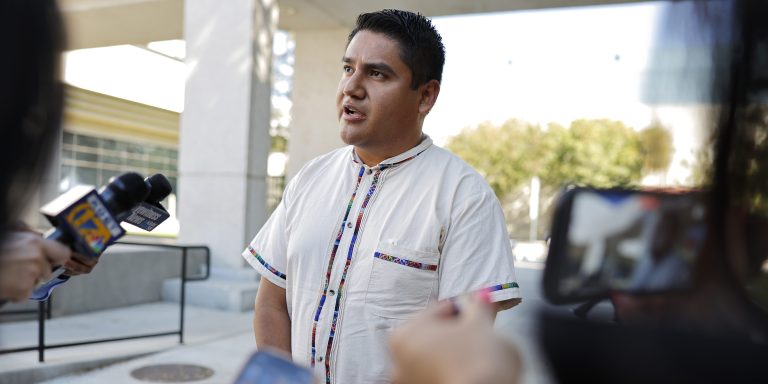
Congressional candidate Will Lawrence, wearing a “No data centers in Mason” hat, speaks at a data center town hall in Mason, Mich., on Sept. 14, 2026.Photo: Nic Antaya/
When progressive Will Lawrence beat two moderates in a Michigan congressional primary earlier this year, some Democrats were worried about his ability to win one of the nation’s most evenly divided districts.
Early Wednesday morning, Lawrence claimed victory over Republican Rep. Tom Barrett. (National news organizations such as The Associated Press had not called the race as of Wednesday morning.)
A national swing in favor of Democrats helped him — but so did a campaign that leaned heavily on opposition to data centers to
situate Lawrence as a populist instead of an extremist.
Data centers were on voters’ minds everywhere, but they rarely dominated a race as much as the 7th Congressional District of Michigan. Lawrence vocally opposed data center construction almost as soon as he began running last year. A series of proposed hyperscale developments in and around Lansing pushed the issue into the limelight.
A month and a half before the election, Lawrence announced a data center platform calling for a moratorium on new development, environmental regulations, and a national jobs program to replace work taken away by artificial intelligence.
As progressives take stock of the 2026 midterms, Lawrence’s approach points one way forward for their wing of the Democratic Party. Lawrence’s opponent tried to turn his time as an environmental activist into a liability, but in an interview with The Intercept, Lawrence said his background primed him to come down on the same side as the public on a red-hot issue like data centers.
“I fought against Wall Street landlords trying to kick people out of their homes. I fought against oil companies who are polluting our air and water,” he told The Intercept in an interview last month. “So for me, this was not the first time that I’ve stood on the line against a corporate behemoth like this.”
From Sunrise to Congress
Lawrence is a co-founder of the Sunrise Movement, which had one of its most famous moments when its youth activists marched into the office of then-House Speaker Nancy Pelosi to push for the Green New Deal with Rep. Alexandria Ocasio-Cortez, D-N.Y., by their side in 2018.
Data centers and AI were remote issues for voters then, but they were starting to bubble up in the public consciousness by the time Lawrence announced his run for Congress in August 2025.
Two months later, one of his first moves as a candidate was to visit public meetings in two small townships in Michigan to express his opposition to proposed data center developments.
As a former member of the Democratic Socialists of America, he drew skepticism from many observers over his ability to win the primary in a district that narrowly voted for Donald Trump in 2024. They were equally skeptical of his ability to beat Barrett, a Republican who tried to play up his moderate bona fides in the race’s final weeks. Barrett was one of a handful of Republicans to vote in favor of a resolution to end the Iran war, for instance.
Lawrence had some major liabilities in a purple district, including tweets where he wrote “fuck the nuclear-family home” and told then-Democratic Sen. Joe Manchin in a song to “hurry up and die.”
While Barrett leaned on those posts and Lawrence’s time with the DSA to cast his opponent as an extremist, the young progressive had a card up his sleeves in the form of the data center issue.
It is the rare cause that leaps across party lines to unite Republicans and Democrats who are just as worried about water
At an October 5 city council meeting in the quaint town of Mason, where a developer has proposed a hyperscale data center on a plot of picturesque farmland, Democrats and Republicans alike said they were outraged. Some residents said they would sell their house and leave town if the development is built.
In a sign of how politically charged the issue has become, many of the speakers were candidates for office angling for votes. Lawrence had dropped by himself a few weeks before. His first television ad centered on his opposition to the Mason project.
Karl Sime, a Mason resident who crisscrossed the area on behalf of Democratic candidates, told The Intercept last month that “100 percent” of voters were angry about the data center proposed for the swath of farmland just outside city limits.
“Sometimes they’ll just say it unprovoked,” he said. “You can see the body language just dramatically change into anger.”
Republican Countermoves
Lawrence was hardly the only candidate who tried to tap into opposition to data centers. Some Republicans tried to catch the wave as well.
Barrett voted for the One Big Beautiful Bill, which included tax breaks that could benefit rural data center developers. But as the danger he faced in the election became clear, he proposed legislation in Congress that would ban local officials from signing non-disclosure agreements with developers and would allow local communities to set regulations on data centers without federal interference.
Some voters said they wanted to see candidates take a harder stance in favor of regulation, however. At the City Council meeting last month, Doug DeLind said he was left shaking his head at neighbors who had yard signs opposing data centers and supporting Barrett.
DeLind, a sculptor who lives near the proposed data center, said that Barrett’s position was that “we’re going to leave it up to the local communities, but we’re not going to provide any federal protection or any guidelines to what a data center can do.”
Although Mason faces a more imminent possibility of a massive data center, Americans across the country are worried about having one in their backyard. Multiple surveys showed a remarkable shift in public opinion on the subject over the past year. Half of Americans oppose a data center being built within 3 miles of their house, according to a recent Politico poll.
In recent months, data centers became a signature issue for Democrats with progressive pasts trying to recast themselves as populists. Sherrod Brown, the party’s Senate candidate in Ohio, and Texas gubernatorial candidate Gina Hinojosa also staked their campaigns on opposition to data centers. Both won.
“The playbook was listening to voters. I think voters across ideologies were speaking with one voice, and I think their opponents were some of the people most willing to silence voters and accept industry cash instead,” said Alex Bores, who became a national figure by arguing for stricter AI regulations during a failed New York congressional primary bid earlier this year.
As candidates ran away from data centers, the artificial intelligence industry’s most powerful super PAC stopped intervening in close races. An Intercept analysis found that the well-funded Leading the Future super PAC network, which is aligned with OpenAI, largely stopped spending in competitive general election races.
It lost in the one state where it did place a big bet, South Carolina. Incumbent Sen. Darline Graham, a Republican, fell to challenger Annie Andrews.
Bores, who now leads a pro-AI regulation group called Who Decides, said he was not surprised to see candidates increasingly market themselves as AI skeptics.
“I think it’s overdue. I think candidates and elected officials are catching up to where the electorate is, across parties,” Bores told The Intercept. “It is remarkable the agreement that voters have around wanting guardrails to protect us from the most powerful and fastest moving technology of our lifetime. Democracy is sometimes slow, but only so much.”
This story was supported by a grant from the Tarbell Center for AI Journalism.
IT’S EVEN WORSE THAN WE THOUGHT.
What we’re seeing right now from Donald Trump is a full-on authoritarian takeover of the U.S. government.
This is not hyperbole.
Court orders are being ignored. MAGA loyalists have been put in charge of the military and federal law enforcement agencies. The Department of Government Efficiency has stripped Congress of its power of the purse. News outlets that challenge Trump have been banished or put under investigation.
Yet far too many are still covering Trump’s assault on democracy like politics as usual, with flattering headlines describing Trump as “unconventional,” “testing the boundaries,” and “aggressively flexing power.”
The Intercept has long covered authoritarian governments, billionaire oligarchs, and backsliding democracies around the world. We understand the challenge we face in Trump and the vital importance of press freedom in defending democracy.
We’re independent of corporate interests. Will you help us?
IT’S BEEN A DEVASTATING year for journalism — the worst in modern U.S. history.
We have a president with utter contempt for truth aggressively using the government’s full powers to dismantle the free press. Corporate news outlets have cowered, becoming accessories in Trump’s project to create a post-truth America. Right-wing billionaires have pounced, buying up media organizations and rebuilding the information environment to their liking.
In this most perilous moment for democracy, The Intercept is fighting back. But to do so effectively, we need to grow.
That’s where you come in. Will you help us expand our reporting capacity in time to hit the ground running in 2026?
I’M BEN MUESSIG, The Intercept’s editor-in-chief. It’s been a devastating year for journalism — the worst in modern U.S. history.
Latest Stories

Democrats, Don’t Mess This Up
With these midterm election results, Democrats have a mandate to fight Trump and deliver for the working class. This is what they should do.
In California’s Central Valley, ICE Might Swing a Red District Blue
As ICE rips through California during the election, progressive upstart Randy Villegas is trying to topple Republican Rep. David Valadao.
Even Anti-Trans Panic Couldn’t Save Republicans in Deep-Red Texas
As James Talarico beat Ken Paxton in a historic Democratic flip, a Republican campaign run on transphobia fell short.

1 Comment
Pingback: Korea seeks another crypto tax delay over gaps in overseas data and rules - Axiom Core