

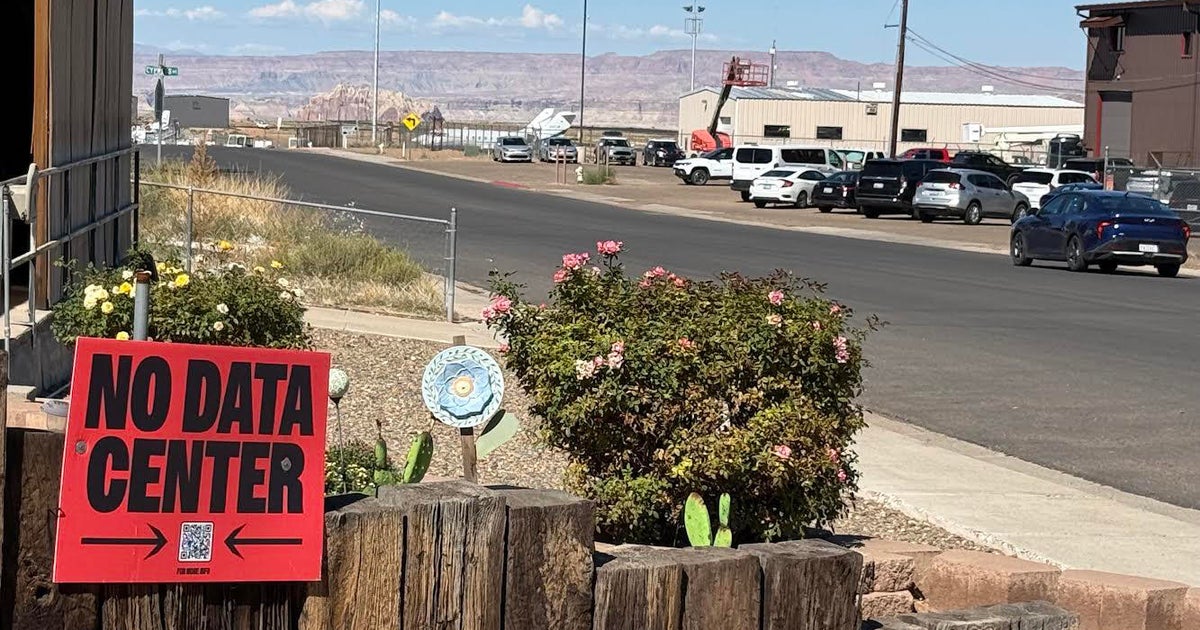
Page, Arizona — Doug Herrera still lives in the house his father built, though his dad died some time ago from cancer. Herrera wonders if that illness could have been linked to pollutants from nearby uranium mining. Now, he worries that a possible new neighbor — a proposed $10 billion mega data center — could imperil his health.
“I’m a patriot, but I’m highly against the data center,” Herrera, 64, said from his front porch near a yard sign that reads “No Data Centers.”
“There is light pollution, sound pollution. The temperature is going to rise,” he said.
Page is a gateway to iconic Southwestern landscapes of arid desert studded with Joshua trees and towering red-rock formations. While the City Council approved the sale of land for a data center, the developer needs zoning and other approvals. Residents concerned about possible health effects have signed petitions and mobilized to oppose construction.
The boom in data centers is dividing communities such as Page and turning future construction into a flash point in the midterm elections. The leading candidates in the close race for Arizona’s 1st Congressional District are at odds over any new centers there, and the state’s attorney general has called for a pause on new approvals and building.
Robert Housman
Emerging research into data centers’ possible health effects is adding grist to the various state fights, giving ammunition to Democrats and some Republicans who’ve broken party ranks to oppose the sprawling complexes.
It has also put some incumbent politicians who have supported data center expansion in unexpectedly vulnerable positions in reliably red states like Ohio and Texas, where the megabuildings now operate by the hundreds.
“Two years ago, a lot of these data centers went up and there was not an organized, watchful opposition,” said Lee Hannah, a political science professor at Wright State University in Dayton, Ohio.
“That opposition has come up in a grassroots way so quickly that decisions made a year ago by local officials or state governments to get behind a data center are suddenly career-ending.”
The hyperscale centers house infrastructure to power AI, with servers that sprawl over tens of thousands of square feet or more. The city of Page approved the sale of 500 acres for the proposed data center, though the location within that acreage hasn’t been decided. The area sits on open land studded with blackbrush and native grasses near Horseshoe Bend, an iconic curve of the Colorado River that has long been popular with tourists.
Data centers gobble up electricity and rely on backup gas generators during times of peak energy demand. The resulting air pollution has been linked to heart conditions, respiratory issues, and elevated cancer risks, according to a number of environmental studies.
Emissions from the centers could cause nearly 1,300 deaths annually by 2030 and an annual public health burden of more than $20 billion in 2028, based on modeling led by researchers at the University of California-Riverside.
Cooling components can contain what are called forever chemicals, synthetic substances that accumulate in human tissue, according to advocacy and environmental groups. And the hum and whir of generators and heating and air conditioning systems can exceed 90 decibels, which can harm hearing.
Data centers are lit up for operations and security, creating light pollution that can increase the risk of chronic disease, the groups say. The megafacilities also create what are known as data heat islands, which are higher-temperature zones caused by intense energy demands.
“We’re just starting to see the very early edge of the wave of the research into health impacts of data centers,” said Alison Steele, executive director of the Environmental Health Project, a nonprofit public health organization. “By the time we have a substantial volume of research it’s going to be too late, because the decisions are being made now.”
A trade group for the data center industry said a review of the largest data center market — Virginia — found that use of backup powerg state and federal regulations limit potential emissions or impacts
“Data centers are committed to being responsible partners where they operate,” said Dan Diorio, executive vice president of state policy and government affairs at the Data Center Coalition.
It cuts across politics
Mounting concerns about data centers are dividing candidates and pitting some GOP contenders against President Trump, who supports the facilities’ construction as vital for economic growth.
Two in 3 Americans oppose the construction of new data centers in the U.S., according to an October Washington Post-ABC News-Ipsos poll.
Such political standoffs are happening largely in states that Mr. Trump won in 2024, where most new data center capacity has been proposed. About 1,400 data centers operate in the U.S., and an additional 2,000-plus are planned.
Sixty percent of data center capacity under construction is in states Mr. Trump won by five percentage points or more a market intelligence company. Excluding Virginia, 92% is in states the president won
Hannah said the uptick in construction has put Mr. Trump’s coalition at particular risk because data centers are often built in rural areas, where the president has often enjoyed insurmountable margins of support.
“This is where most of the data centers go,” Hannah said. “They go into red states, because Republicans are less critical of economic opportunity. If it promises jobs and money, they’re all in.”
In Page, signs opposing construction pepper front yards.
The opposition to more data centers in the state could pose political risks for GOP House candidate Jay Feely, who won his primary with an endorsement from Mr. Trump. He says they are key to keeping up with China. Democratic opponent Amish Shah wants a pause on new construction in their district.
The House seat they’re vying for is considered competitive, and the contest could be pivotal in determining which party gains House control after the Nov. 3 midterms.
In Arizona, 57% of registered voters oppose construction of more large data centers, according to an August opt-in online poll of 1,040 registered voters by Noble Predictive Insights.
More than costs
Photos from across the nation featuring politicians at groundbreaking ceremonies for data centers held only a year or two ago are now campaign fodder.
That has become a big problem for some elected leaders in Ohio, where more than a dozen local referendums or initiatives related to construction of the facilities will appear on ballots — the most of any state.
The issue has forced its way to the forefront of the state’s marquee U.S. Senate race. Former Sen. Sherrod Brown, a Democrat, is hoping to return to Congress with pointed attacks against Republican Sen. Jon Husted over the matter.
Roughly $2.5 billion in state and local tax breaks over the last decade have prompted Meta, Amazon, Google, and other tech companies to erect dozens of data centers across Ohio. That boom has spurred protestsacross the state, organized by local residents who are worried about the health, environmental, and financial impact of the structures.
Brown has pinned the blame on Husted directly with ads airing widely across Ohio that call him “the face of data centers.”
“They’re devouring our farmland, sucking up our water, and using our energy,” Brown says in one recent video.
A memo circulated by the National Republican Senatorial Committee in August and obtained by Politico described Brown’s critiques as a big problem for Husted.
“More than any other thing in this race, data centers are the anchor hanging around Husted’s neck,” warns the Aug. 18 memo, which was shared with artificial intelligence companies.
Husted has rebuffed these critiques by framing the construction of data centers as a local issue. More recently, he has said he wants to make sure that the companies building data centers pay for infrastructure costs, including energy.
In a statement, Husted spokesperson Tom Evans reiterated that point, saying the senator believes “data centers should remain a local decision.”
It’s not just costs that voters care about. An early-October opt-in survey of 1,650 Ohio adults by Ohio Northern University and SurveyUSA found that 55% were opposed to data center construction. About two-thirds had a negative opinion of data centers’ impact on their community’s environment, and about half said the same about their impact on quality of living.
Opponents of data centers cite noise, air, and water pollution as a concern, according to a Gallup poll. Americans are more opposed to data centers in their area than nuclear power plants.
The air pollution comes from gas turbines and diesel generators that have been linked to cardiovascular problems, asthma, and other health risks. Cooling system chemicals, heavy metals, and construction runoff can enter the water supply or rivers.
“When they are fired up and powered by diesel, they emit a lot of air pollution like nitrogen oxide, and this pollutant can travel around the community and to those downwind,” said Shaolei Ren, an electrical and computer engineering professor at the University of California-Riverside.
In Page, residents in July voted out the mayor amid backlash over the Council’s approval of the land sale for the data center. Opponents of data centers say it’s a warning to candidates in the midterm elections who back new construction.
Some residents in this picturesque town of about 7,000 people remain worried that the health effects could plague them if the project goes forward. Jan Boehme lives in a neighborhood close to the proposed site. From her front lawn with its “No Data Center” sign, she said she is concerned that a data center could become her new neighbor — and cause harms such as hearing loss.
“We’re against it,” she said. “In this area, there are a lot of houses, and I’m concerned about all the noise.”
KFF Health Newsis a national newsroom that produces in-depth journalism about health issues and is one of the core operating programs atKFF— the independent
