


GOP dares Democrats to oppose data center pricing bill
Fox News chief congressional correspondent Chad Pergram has the latest on Republicans testing Senate Democrats with a data center pricing bill on ‘America Reports.’
NEWYou can now listen to Fox News articles!
For most of American history, national defense has been understood geographically. There was American territory and foreign territory, borders to defend, military installations to protect, and American forces stationed around the world. Even as warfare evolved, the basic concept remained relatively simple: the United States had physical assets that needed protection from foreign adversaries.
Technology has fundamentally changed that calculation. Today, some of the most important assets supporting America’s economy, military and national security do not fit neatly within traditional definitions of territory or defense infrastructure. They are data centers, cloud-computing systems, telecommunications networks and other digital infrastructure that may be privately owned and located thousands of miles from the United States.
The border of the next war may not be a line on a map. It may be a data center.
OUR ENEMIES FOUND A WEAKNESS IN ESSENTIAL TECHNOLOGY. WE MUST FIX IT … FAST
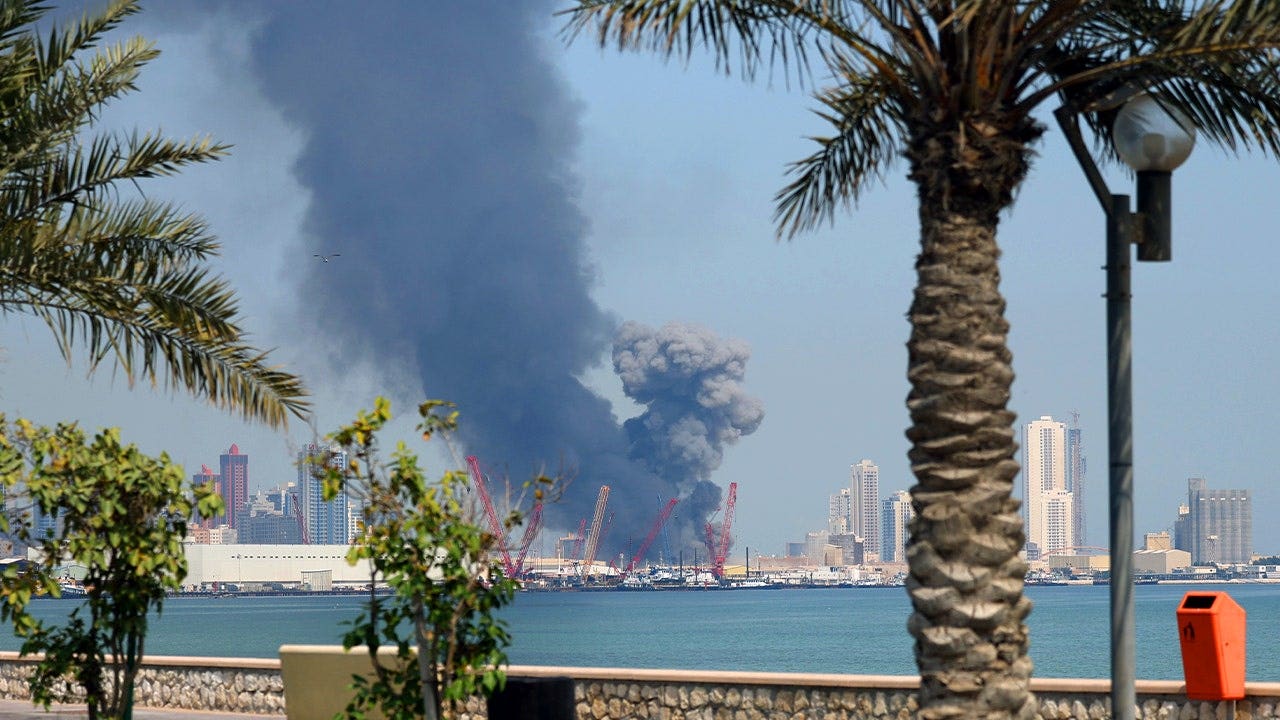
The recent conflict with Iran should force Washington to take that possibility seriously. In March, Iranian strikes damaged Amazon Web Services data centers and infrastructure in the United Arab Emirates and Bahrain, disrupting cloud infrastructure and creating problems with power and connectivity. Reuters reported that the damage contributed to service disruptions and an extended recovery process. Then, in April, Iran’s Islamic Revolutionary Guard Corps publicly claimed that it had targeted an Amazon cloud-computing facility in Bahrain.
The aftermath of an Iranian missile strike on a Navy 5th Fleet installation in Bahrain is shown above. Iran also attacked an Amazon AWS facility there.(Stringer/Anadolu
That distinction is important. This was not simply a commercial facility caught in the crossfire. Iran publicly identified American commercial computing infrastructure as a target.
8 EVERYDAY THINGS THAT WOULD QUIT WORKING WITHOUT DATA CENTERS
That should be a warning for Washington. American power increasingly depends on infrastructure that is privately operated and, in some cases, located outside our borders. The military relies on commercial technology and cloud computing. Financial institutions depend on digital infrastructure to process transactions and maintain operations. Hospitals, communications networks, logistics companies and energy providers all depend on interconnected systems. <a href="https://axiomcore.info/ai-is-being-taught-how-to-do-your-job-will-artificial-intelligence-replace-us-or-just-change-the-way-we-work/” title=”AI is being taught how to do your job. Will artificial intelligence replace us, or just change the way we work?”>Artificial intelligence, which is becoming important to both the American economy and national defense, requires enormous amounts of computing capacity and data.
The building may be privately owned, but the consequences of destroying it may extend far beyond the company that operates it.
AN AI CYBERATTACK COULD TURN OFF AMERICA’S LIGHTS BEFORE WASHINGTON EVEN UNDERSTANDS WHY
The federal government already recognizes that infrastructure can have national-security implications even when it is not owned by the government. Federal law defines critical infrastructure broadly, including physical or virtual systems and assets whose incapacity or destruction could have a debilitating impact on national security, national economic security, public health or safety.
But our national-security strategy has not fully caught up with the technological transformation of the American economy and military. A generation ago, it was relatively easy to understand why a power plant or port could be considered strategically important. Today, the same logic increasingly applies to the infrastructure that makes the digital economy possible. A data center supporting military logistics, financial markets, telecommunications or advanced artificial intelligence may be just as consequential to national security as a physical facility traditionally associated with defense.
AMERICA RUNS ON DATA. IF WE DON’T BUILD THE INFRASTRUCTURE, CHINA WILL
The Trump administration has recognized the importance of data-center infrastructure to the internet, cloud computing, artificial intelligence and America’s economic and national security. Congress should build on that recognition by creating a designation for exceptionally important American-owned or American-controlled digital infrastructure.
The designation should be narrow and subject to rigorous requirements. It should not turn every data center into a national-security facility or give private companies a blank check for government protection.
US ADVERSARY TURNS UP THE HEAT ON AMERICA’S AI LEAD WITH AN UNDERESTIMATED EDGE
Companies seeking the designation should have to meet strict standards concerning ownership and control, cybersecurity, physical security, supply-chain integrity, redundancy and cooperation with U.S. national-security agencies. The federal government could then identify the relatively small number of facilities whose destruction or prolonged incapacitation would pose a serious threat to American national or economic security.
American power increasingly depends on infrastructure that is privately operated and, in some cases, located outside our borders.
These could include data centers supporting military operations, financial markets, critical communications, government systems or strategically important artificial intelligence capabilities.
IRAN-LINKED HACKERS SUSPECTED IN UK POWER-PLANT SHUTDOWN AFTER ALLEGED MINNESOTA WATER ATTACK
The designation would not make these facilities American territory. A data center in Bahrain would not become sovereign American territory simply because it was designated a protected strategic asset. But it would establish something equally important, a clear American policy that deliberately attacking certain strategically vital infrastructure carries consequences.
That clarity serves an important purpose: deterrence.
IF HACKERS CRIPPLE AMERICA’S WATER, THE CONSEQUENCES COULD BE CATASTROPHIC
Congress should establish a range of potential responses that could include sanctions, asset freezes, diplomatic measures, defensive cyber operations and, depending on the circumstances and attribution, additional measures authorized by Congress.
The goal should not be to automatically escalate every attack into a military confrontation. The goal is to make the consequences sufficiently clear that an adversary thinks twice before attacking.
AMERICA AND CHINA ARE FIGHTING FOR THE FUTURE OF AI
Artificial intelligence (AI) only raises the stakes. AI is becoming an ever-more important component of intelligence analysis, cybersecurity, logistics, communications, autonomous systems, military planning and economic competition. President Donald Trump’s June 2026 National Security Presidential Memorandum on artificial intelligence (AI) recognized this reality by directing the national-security enterprise to accelerate AI adoption and strengthen partnerships with private industry.
A protestor crashed a pro-data center party in Washington, D.C., claiming the technology is “killing the world.”(Vince Natale)
But that raises a critical question: What happens if the infrastructure supporting those systems is attacked?
An adversary may not need to destroy an AI system directly. It could target the data center where the computing takes place, disrupt the electricity supplying the facility, compromise the communications infrastructure connecting it to other systems or attack the supply chain supporting its operations.
If America becomes increasingly dependent on artificial intelligence without protecting the infrastructure underneath it, a strategic advantage could quickly become a strategic vulnerability.
Computing capacity is becoming part of national power. Protecting it needs to become part of national defense.
Our adversaries already understand this. Russia has demonstrated its willingness to use cyber operations and attacks against infrastructure as instruments of state power. China has invested heavily in cyber capabilities and studied vulnerabilities created by America’s dependence on interconnected systems. Iran has demonstrated its willingness to use cyber and other asymmetric capabilities against American interests.
They understand that attacking the United States does not necessarily require attacking an American military installation.
The federal government could then identify the relatively small number of facilities whose destruction or prolonged incapacitation would pose a serious threat to American national or economic security.
An adversary could disrupt a power grid, interfere with a port, target a telecommunications network, compromise a financial system or attack the computing infrastructure supporting critical services. That is why digital infrastructure can no longer be treated merely as a technology issue. It is a national-security issue.
For generations, the United States has developed military and diplomatic doctrines designed to deter attacks against the country and its interests. The digital age requires us to expand that thinking.
Congress should establish a framework for identifying the digital infrastructure so important to American national security that its intentional destruction would warrant a significant U.S. response. The administration should then work with allies to develop reciprocal protections for strategically important infrastructure located overseas.
Companies operating designated facilities should also be expected to meet high standards for cybersecurity, physical security, redundancy and resilience. Protection must come with responsibility.
Deterrence does not require eliminating every threat. It requires making the cost of an attack sufficiently clear that an adversary decides the risk is not worth taking.
The United States cannot defend 21st-century power with a 20th-century understanding of national security.

Our borders still matter, and our military installations, ships and aircraft remain essential to national defense. But so do the servers, networks, data centers and computing systems that allow those traditional instruments of power, and increasingly, our entire economy, to function.
The next major attack on American interests may not begin with troops crossing a border or missiles striking a military installation. It could begin with the loss of computing capacity, the disruption of a communications network or the failure of a system most Americans have never heard of, but millions depend upon.
Iran has provided a warning about what that future could look like.
CLICK HERE FOR MORE FOX NEWS OPINION
The battlefield is expanding beyond traditional military targets and physical borders. America’s national-security strategy must expand with it.
The border of the next war may not be on a map. It may be the infrastructure that keeps America running.
CLICK HERE FOR MORE FROM KATE MONROE

1 Comment
Pingback: Trump announces members of ‘Super Intelligence Force’ to coordinate AI policy - Axiom Core