

See all topics
Ulanqab, Inner Mongolia —
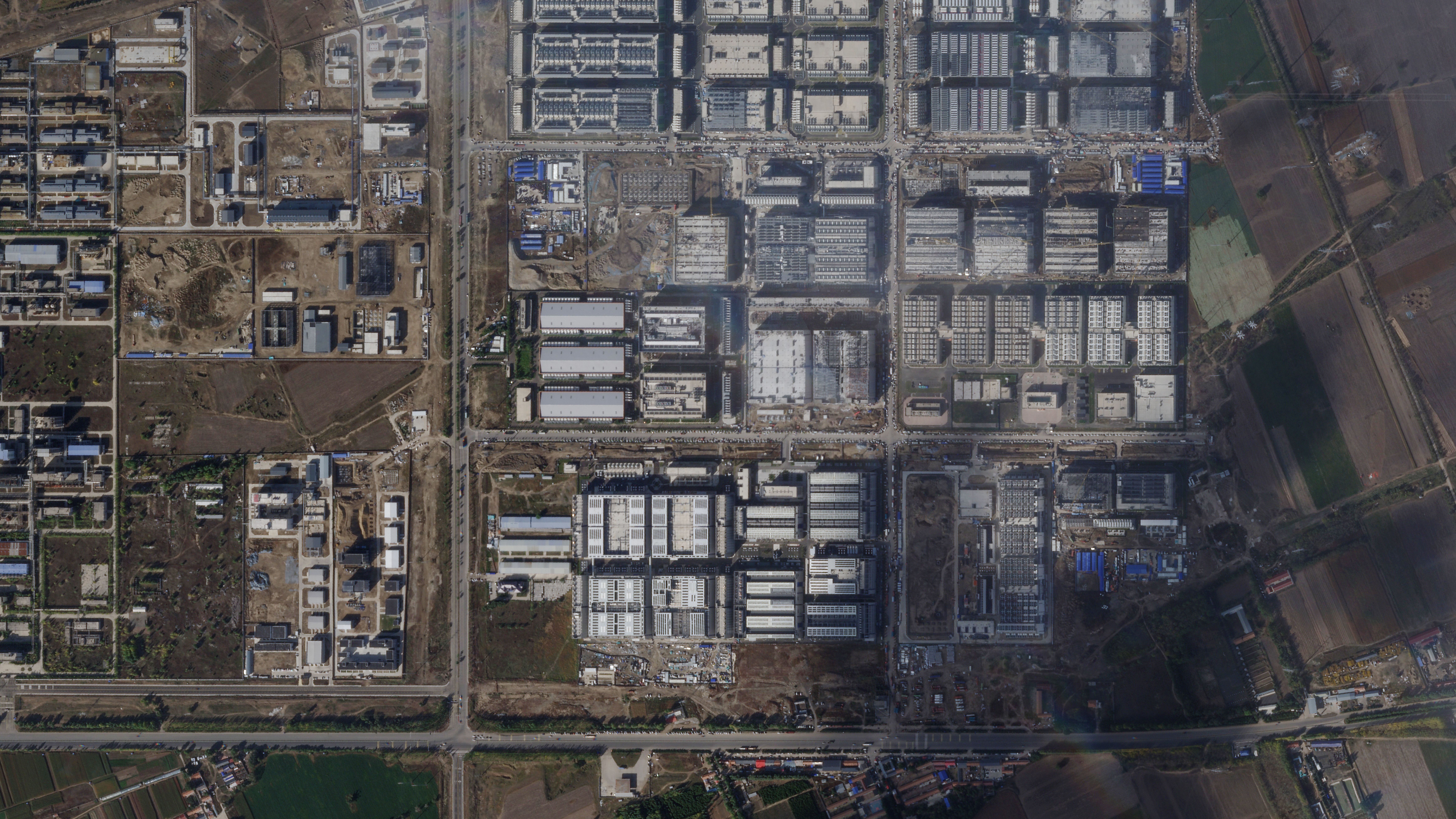
The area appears like a high-tech mirage. Block after block of hulking <a href="https://axiomcore.info/ukraine-struck-yandex-data-centers-russian-bots-went-silent/” title=”Ukraine Struck Yandex Data Centers, Russian Bots Went Silent”>data centers – both new and under construction – rise up seemingly out of nowhere from rolling plains and fields of sunflowers and sorghum.
On their sides are some of the biggest names in Chinese tech – hardware giant Huawei, social media platform Kuaishou, service provider VNET – all packed into a zone thrumming with bustle and movement.
This is Ulanqab, Inner Mongolia, a Chinese city on the edge of the Gobi desert. It’s fast becoming one of the data hubs fueling a massive AI boom in China that’s made the country the only serious rival to the US’ ambitions to dominate the technology. Nearly 90 data centers are slated to be built in this city of fewer than two million people.
As of last year, the US had roughly 10 times more AI datacenters than China, according to Stanford University research – and vastly more computing power, other estimates show. American tech firms have something China’s don’t: access to the most advanced chips, the single most important ingredient for developing AI.
Inside China’s push to win the AI race
3:04•
But Ulanqab – with its growing number of AI and big-data centers – showcases the advantages on China’s side in the race for the technology that could define the 21st century.
The towering units here were constructed at breakneck speed, with most of the densely packed Bayin Big Data Industrial Park taking shape in just two years, testament to China’s capacity to build fast.
Heavy winds, beating sun and wide, open spaces give the area plentiful access to cheap green energy and land.
And, crucially, throughout the Communist Party-run country, public opposition to the mass construction of data centers – the kind that is making headlines in the US – is non-existent.
At Ulanqab’s Bayin industrial park on a recent weekday, a steady stream of construction workers had their faces scanned as they filed past guards to enter building sites, while trucks rumbled along, feeding supplies to the facilities taking shape within. Outside their perimeters, vendors hawked noodles and cigarettes from makeshift stalls.
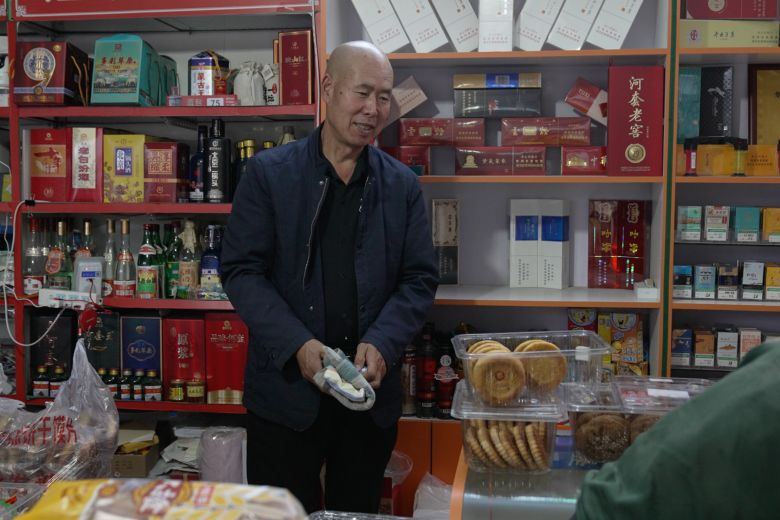
Grocery store owner Ma Rong has run his business in Ulanqab, Inner Mongolia for 30 years.
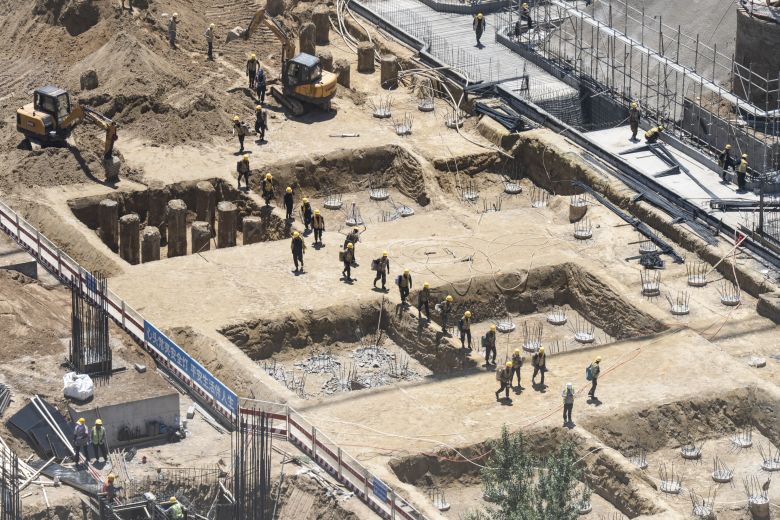
Workers at a construction site in Hohhot, Inner Mongolia in June.
The din of construction didn’t appear unwelcome to locals living nearby. Some who spoke to CNN said they were benefiting from the projects – and the influx of migrant construction workers that came with them to an area whose economy was otherwise largely reliant on agriculture.
“Before, we’d just sit there and wait for customers. Now we’re constantly busy – picking up orders, doing this and that. We barely get a break,” said Ma Rong, 56, who has run a grocery store and guest house in the area for the past 30 years. “Our business has gotten much better than before,” he said.
Some have been uprooted by changes sweeping the region, like restaurant owner Liu Baoping, 58, who said he had to leave his original business location due to the demolition of a highway. But he describes his daily clientele as doubling alongside the data-center buildout. “The environment isn’t as clean as before, but people’s incomes and the economy – it’s way better,” he said.
Construction is in full swing at Ulanqab’s Bayin Big Data Industrial Park on September 24, 2026.
Ulanqab is part of Beijing’s vision to rapidly scale up data infrastructure – a key priority for a government that sees AI as a crucial engine of growth for the country’s slowing economy with its shrinking population.
“China has embraced AI with open arms,” Chinese leader Xi Jinping told a global artificial intelligence conference in Shanghai this past July. He pointed to China’s initiative to inject AI into sectors from health to home goods and hailed its push to embed AI in manufacturing as a “shining hallmark of Chinese modernization.”
Already more than 700 million people use AI in China, according to official statistics. And the plan to weave AI across manufacturing, industry and daily life also requires massive amounts of compute.
Beijing last month announced a $560 billion plan to rapidly scale up information infrastructure, including computing facilities, over the next five years. Private tech companies are also ramping up investment in AI infrastructure, though they still trail their Silicon Valley peers by a longshot.
Such investment from listed Chinese companies will double this year to around $139 billion, according to research firm Rhodium Group. But that is still less than one-fifth of the $800 billion in AI data center investment from their US peers.
And that’s not the only bottleneck.
Chinese firms face another critical challenge: limits on the amount of high-end hardware available to fill these centers. Washington’s export bans restrict their access to the best AI chips, like certain models from Nvidia and AMD, while Beijing has restricted imports of some less powerful options. Domestic chipmakers are racing to catch up, but their tech still lags the US – and supplies of their cutting-edge models are tight.
“If you look at the overall production cost of building a data center, chips are the most important factor, and they just don’t have enough,” said Nick Corvino, a researcher at the Carnegie Endowment for International Peace.
But what China lacks in chips and capital, it’s trying make up for with an advantage: ample, affordable power, much of it green.
While energy-hungry data centers are straining an aging US grid that’s not expanded significantly in decades, China between 2022 and 2025 added capacity equivalent to that of industrial power
And it has more green power than it can use: the country wasted enough excess green energy in the first six months of 2026 to power the entire country of Mexico for a year, findings from independent research organizations the Centre for Research on Energy and Clean Air and Global Energy Monitor suggest.
Sheep graze near wind turbines in Ulanqab, Inner Mongolia last month.
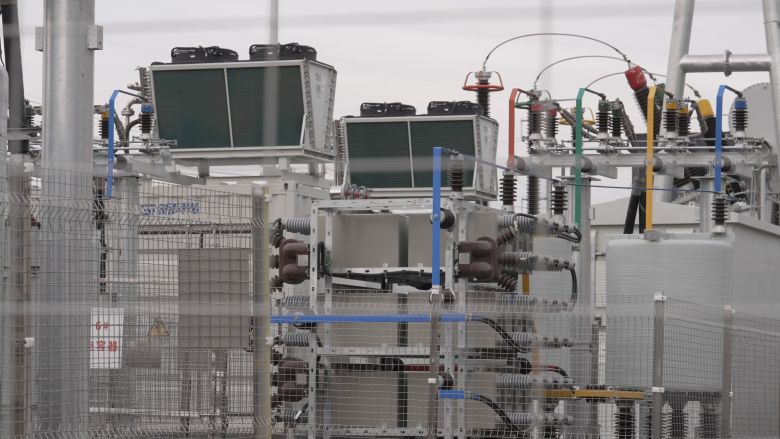
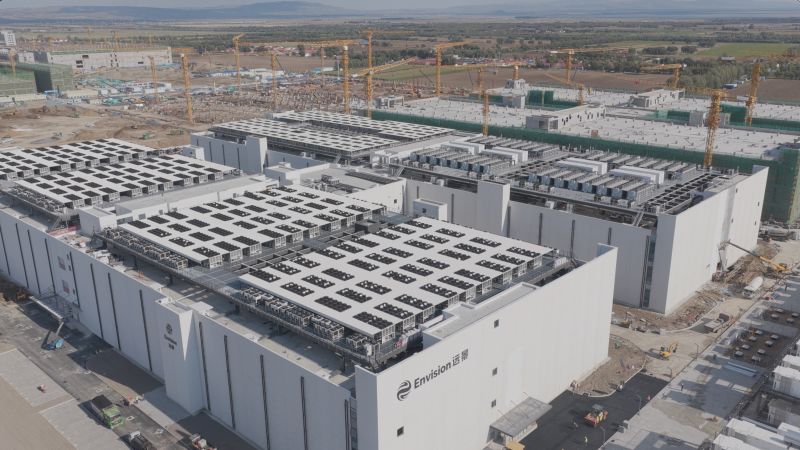
Power infrastructure at green tech company Envision’s AI data center in Ulanqab, Inner Mongolia.
Beijing wants data centers to sop up that excess – much of it in western, rural areas where sun, wind and land are plentiful – while boosting business for its green tech sector, under a plan known as “Eastern data, Western compute.”
Under that strategy, first launched in 2022, China has designated eight national computing hubs – including several in its west – and 10 national data center clusters. Its latest five-year national economic blueprint elevated the linkage further, calling for pairing the build-out of computing infrastructure and green energy.
“China’s trying to take advantage of the fact that it has this muscle memory for building energy (infrastructure) quickly,” said Kyle Chan, a fellow at the Brookings Institution. “Whereas for the US, we haven’t done this kind of grid buildout in a long time and so we are struggling on the power generation and grid connection front.”
Abundant power can also help China make up for its less powerful domestic chips. Chinese chip designers like Huawei are combining clusters of chips to create the computing power of superior tech. The fix can be effective for some tasks, analysts say, but uses significantly more electricity.
Observers say that even with ample power, Beijing’s vision has its limits.
Some computing hubs in the west are too far away to handle certain tasks at the speeds needed for urban hubs in the densely-populated east. There’s also concern about so-called “ghost data centers” or ill-conceived projects in rural areas, built to fit a topline government initiative, yet lacking the hardware or users to justify the investment.
But in hubs in Inner Mongolia, where optical cables can transmit data to Beijing – some 200 miles away – faster than the blink of an eye, and top players are pouring major re
Long one of China’s top coal producers, the wind-swept region bordering Russia and Mongolia has more recently become a hub for green energy.
Fields of solar panels blanket parts of Inner Mongolia, while the slender silhouettes of wind turbines spin above grazing sheep. Along some stretches of highway unused turbine blades line the roadsides like giant, fiberglass elephant tusks.
Wind turbines around 100 miles from Envision’s Galaxy Campus contribute power directly to the facility.
In Ulanqab, which falls within one of China’s 10 national data center clusters, nearly half the grid draws from wind and solar – and some data center providers are finding ways to rely even more heavily on clean
Several miles from the thrumming construction of Ulanqab’s Bayin industrial park, the Envision “Galaxy Campus” is running one such model.
Spanning more than 20 football fields and slated to be among the world’s largest by area when completed, this data center will be home to servers and chips from tech companies, used to handle queries users input into AI apps in places like Beijing.
Upwards of 80% of the power for the facility will come directly from wind farms operated by the company, bypassing the grid completely, Envision says.
Battery systems then store wind power, while a cutting-edge solid-state transformer can rapidly adjust how much power is feeding the servers, based on demand the facility’s general manager, who showed CNN around the under-construction campus on a recent day
Water is another key re Zheng says it’s not an issue here. The chilly climate in Ulanqab reduces the need for cooling overall, while the facility is running a so-called “zero-water” system that uses industrial alcohol as coolant, he says
Zheng also seemed optimistic when it comes to demand from tech companies for their facilities – and those clients’ ability to kit out server racks with needed hardware.
The Envision Galaxy Campus in Ulanqab, Inner Mongolia is being built in phases.
The first phase of the planned total 2GW facility was already fully booked, he said, and the company was building additional phases, both for AI and cloud services.
AI chips and servers “are owned by our off-takers,” he said. “When they give us the order to build such a big data center … they were confident to have enough infrastructure to be installed in these (server) racks.”
And this company, like Ulanqab itself, is planning to be ready for an expected surge in AI demand in the coming years.
“We designed this for the next 10 years,” said Zheng. “You need to get prepared for the future.”
CNN’s Joyce Jiang contributed to this report.
